
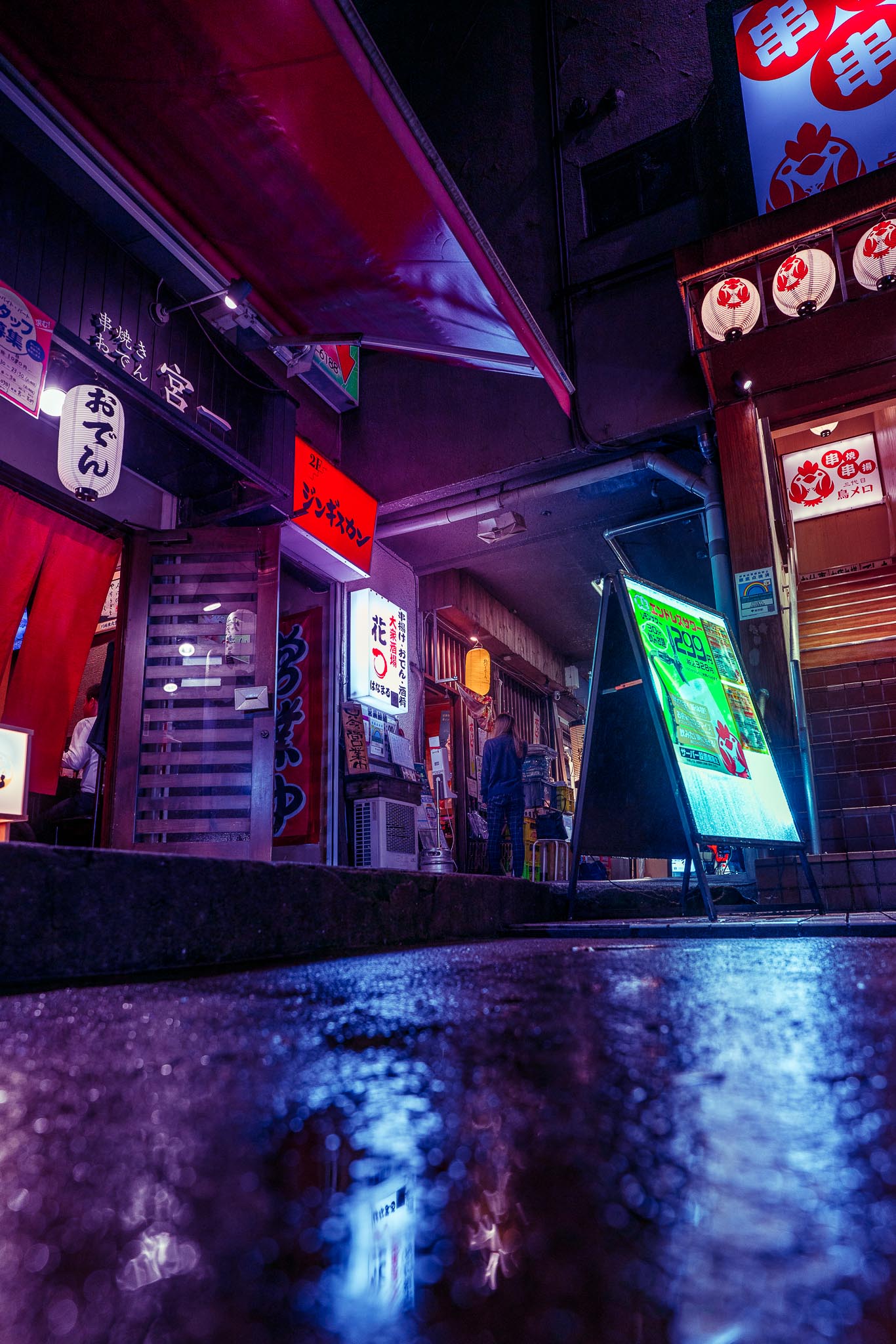
Bubaigawara is a stop on the JR Nambu line in Fuchu, west of the city centre, and it has no particular reason to exist as a destination. There's no famous temple, no known food scene, no photography account built around it. The name comes from a medieval battle fought on the riverbanks here in 1333 — part of a civil war that reshaped the imperial court. The neighbourhood has had seven hundred years to move on, and mostly it has. What's left is a quiet, slightly weathered residential area with a cluster of izakayas near the station and streets that go dark fast once you leave them.
I got off at Bubaigawara because I was on the Nambu line heading somewhere else and the name made me curious. That's the whole origin story. I came back four more times.
What Bubaigawara Actually Is
It's a local station serving people who live nearby. The area immediately around the exit has the infrastructure any residential Tokyo neighbourhood needs — a supermarket, a pharmacy, a few convenience stores, some small restaurants. The izakaya cluster near the station is modest in scale but genuine in character: places that have been there for years, serving the people who walk home past them every night. Nothing is performing for an audience that isn't already here.
This is the version of Tokyo that exists everywhere but gets photographed almost nowhere. The city is enormous — 37 million people in the greater metropolitan area — and the overwhelming majority of those people live in places that look like Bubaigawara, not like Shinjuku or Shibuya. Ordinary streets, local shops, a vending machine on the corner as the brightest light on the block. Understanding this is useful for photography, because it shifts what you're looking for.
The Photography Case for Going Somewhere Like This
The argument for shooting in a neighbourhood nobody has heard of is simple: the images don't look like anyone else's images. Tokyo photography has a dominant aesthetic — neon density, Shibuya crossings, Shinjuku at midnight — and it's a real aesthetic, worth pursuing. But it's also saturated. Thousands of photographers make those frames every week. The images that stand out are increasingly the ones made somewhere the camera hasn't been pointing.
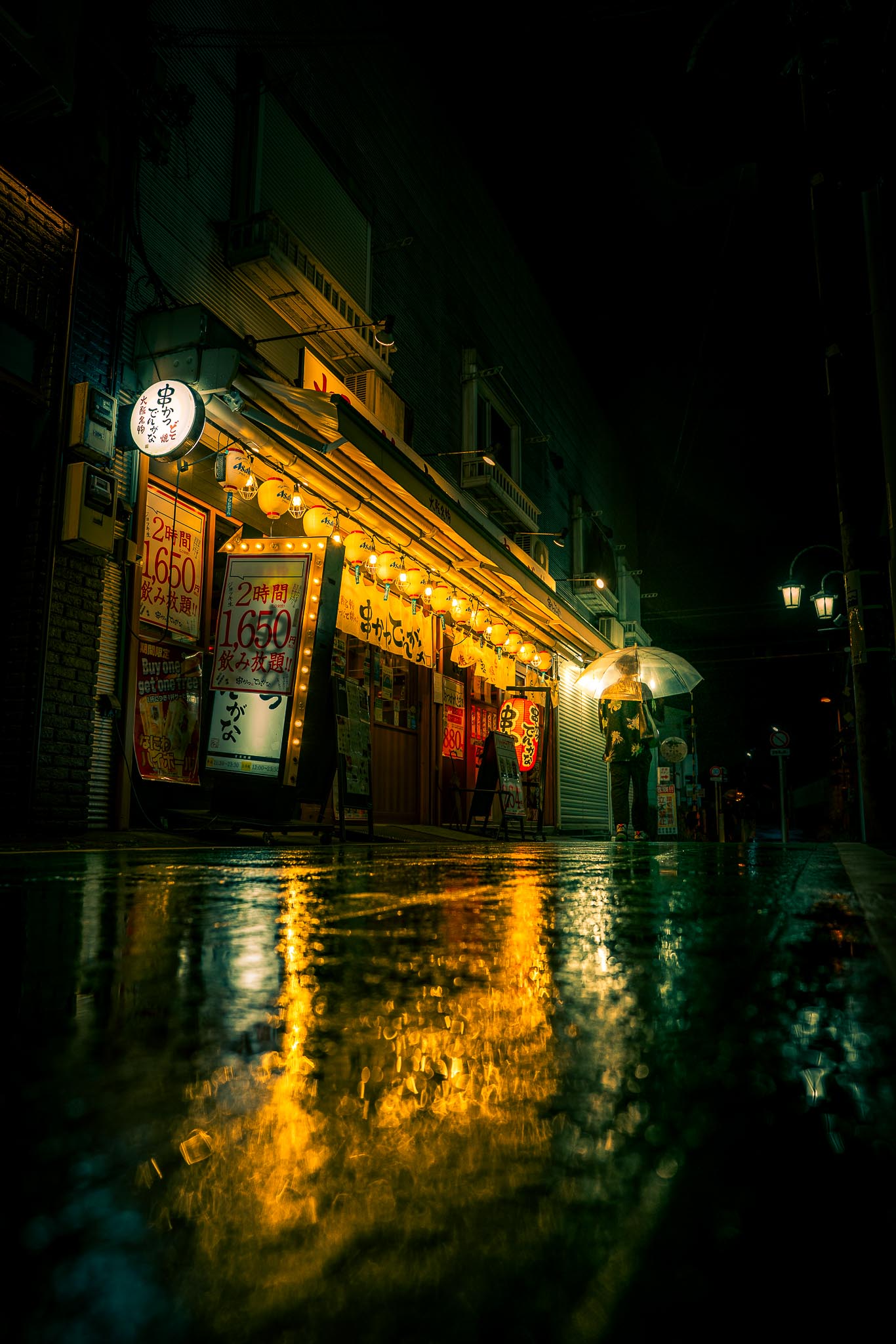
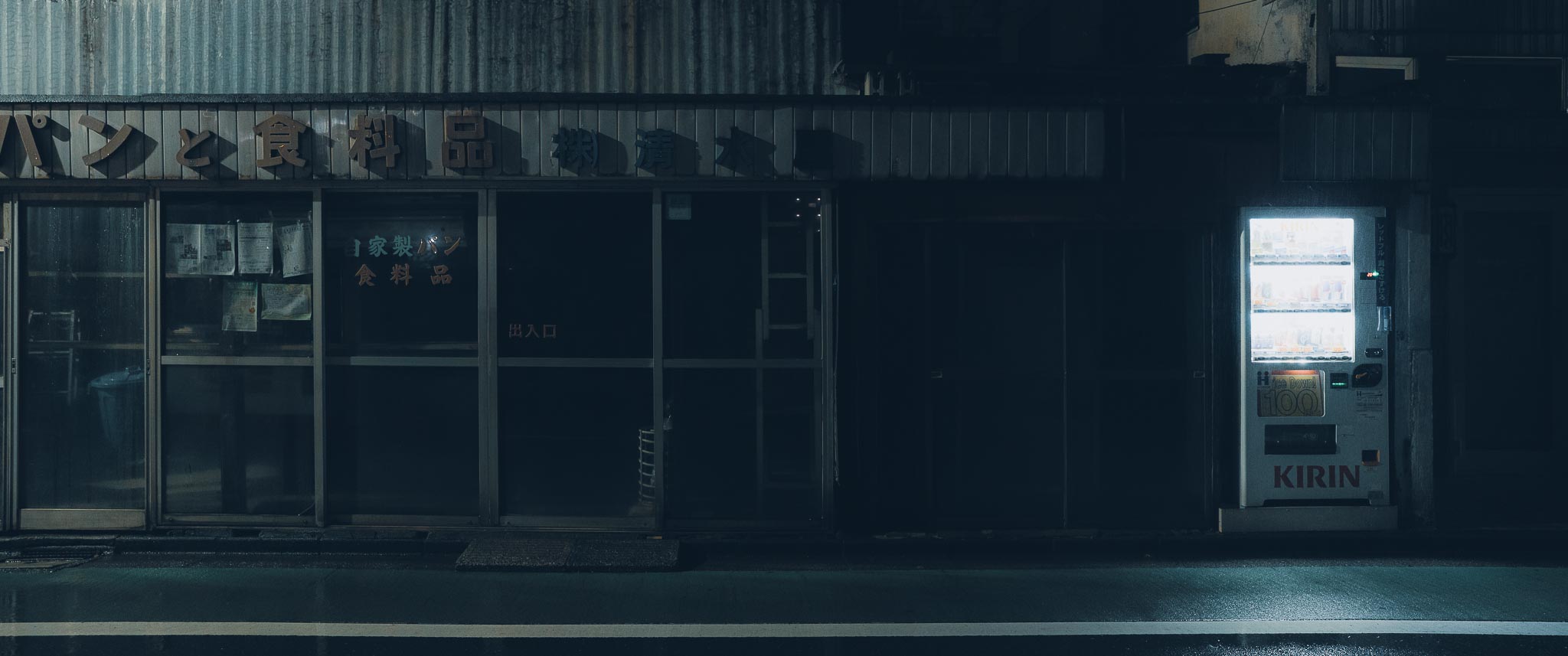
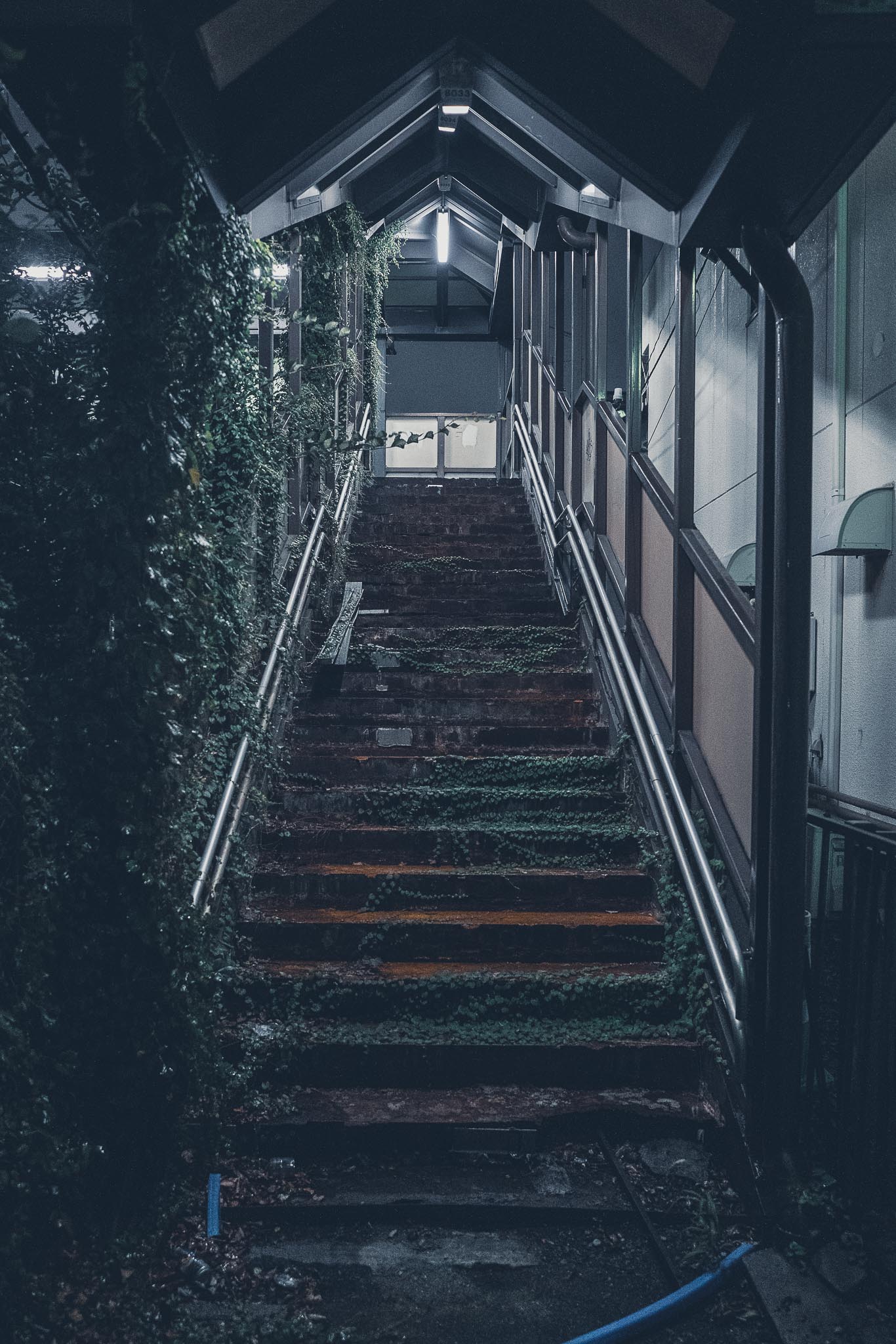
Bubaigawara offers material that's genuinely different. The light here is incidental rather than designed — a single izakaya sign casting amber across wet pavement, a fluorescent strip above a staircase nobody has cleaned in years, a vending machine doing all the visual work on an otherwise completely dark street. These aren't the compositions you plan. They're the ones you find when you're walking slowly through a neighbourhood that has no reason to impress you.
The rain sessions here were some of the most productive I've had in the city. At ground level, on wet pavement, with a single light source reflected into the frame, the images compress into something that reads as deliberate without being staged. The low angle removes context — you could be anywhere and nowhere, which is its own kind of truth about a place like this.
Decay as Subject Matter
One of the things Bubaigawara has in abundance is evidence of time. Buildings that haven't been renovated. Shop signs that predate current design sensibilities. Staircases where the plant life has made a serious claim on the structure — ivy working its way through rusted railings, moss in the gaps between steps, the whole thing covered by a peaked roof that keeps the rain off but doesn't stop anything else. These buildings aren't ruins. People use them. But they carry their age visibly in a way that central Tokyo, with its constant cycle of demolition and construction, rarely allows.
For photography this is productive material. Age creates texture. Texture creates depth in a frame. A closed bread shop at midnight — corrugated metal shutters, handwritten menu still taped to the window, a Kirin vending machine next to it as the only operating light source — is a more interesting photograph than a clean commercial storefront because it has a history you can read in the surfaces. You don't need to know the history. The camera picks it up anyway.
Getting There and Getting Around
Bubaigawara Station is on the JR Nambu line, served by trains from Tachikawa in the west and connecting toward Kawasaki to the south. From central Tokyo the most direct route is typically via Musashi-Kosugi or Tachikawa depending on your starting point. It's not a short trip from Shinjuku — plan for 40 to 50 minutes — which is part of why nobody goes. The commitment of getting there filters out casual visitors, which is most of what keeps the neighbourhood the way it is.
Once you're there, the area worth exploring is compact. A 20-minute radius from the station exit covers most of what's interesting. The streets directly north of the station have the izakaya cluster. The residential streets east and west get quieter quickly and reward a slower, more observational approach. There's no map to follow. You're just walking and paying attention.
The Izakayas: Small, Local, Worth It
The eating and drinking options near the station are not remarkable in the way that notable Tokyo food destinations are remarkable. They're remarkable in a different way: they're entirely for the people who live here. No tourist markup, no English menu, no awareness that anyone from outside the neighbourhood might walk in. The yakitori places have counter seating, a chalkboard menu, and prices that reflect the actual cost of running a small business in a neighbourhood where the rent is nothing compared to central Tokyo.
The dynamic inside these places is the same as any honest local izakaya in Japan. You sit where there's space. The person next to you may or may not want to talk. The bartender is busy. The food is straightforward and good. If you're comfortable with ambiguity — ordering by pointing, accepting what comes — the experience is genuinely enjoyable. If you need an English menu, this isn't the right stop on the Nambu line.
Why Come Here at All
The honest answer is that Bubaigawara is for a specific kind of curiosity. If what you want from Tokyo is the greatest hits — Shibuya crossing, Shinjuku neon, Akabane's izakaya alleys, Ochanomizu's Kanda River — then Bubaigawara is not a priority. Those places earn their reputations and the trip to Tokyo is short for most people. Use your time accordingly.
But if you've already done those places, or if you're in Tokyo long enough that you want to understand the city rather than just visit it, then getting on the Nambu line and riding to a station where nobody is expecting you is one of the better things you can do. The Tokyo that exists in Bubaigawara is the Tokyo that most Tokyo residents actually live in. There's value in seeing that, separate from whatever photographs you make while you're there.
I've been to Bubaigawara five times now. I've never seen another photographer. I've also never come back empty-handed.
Want to shoot somewhere nobody else is pointing a camera?
Book a Session in Tokyo →