
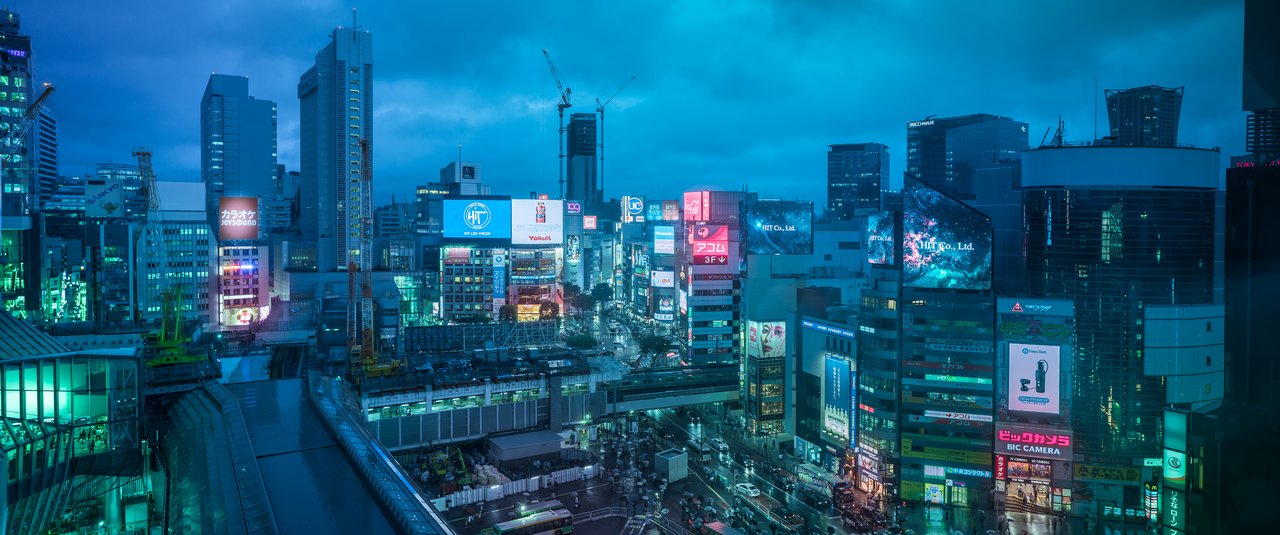
Shibuya night photography is one of the most searched topics in the Tokyo travel space, and the results are almost always the same shot: the Scramble crossing from above, motion blur, 10 million people. It's a real image. It's also been made a few thousand times. If you're coming to Shibuya after dark with a camera, you can do better — and it starts with understanding that the crossing is one stop on a longer walk, not the destination.
I've shot Shibuya more than almost anywhere else in Tokyo. Here's what I've figured out across 900 frames.
The Scramble Crossing: What Actually Works
Go once. Shoot it. Get it out of your system. The classic elevated angle — from the Starbucks on the second floor of Mag's Park, or from the observation area nearby — works, but it's the angle everyone uses. If you want a frame that doesn't look like every other Shibuya crossing photo, try street level with a long lens, isolating one person cutting diagonally across against the crowd. Or find a position slightly off-center where you get depth and foreground interest. The wide shot from above is the easy version. The interesting version takes patience.
The best light at the crossing is around blue hour — roughly 30 minutes after sunset. The sky still holds some color, the crossing lights and signage are fully on, and the exposure balance is manageable without going full artificial-light. This window is short. Be there early.
Dogenzaka: Where Shibuya Night Photography Gets Interesting
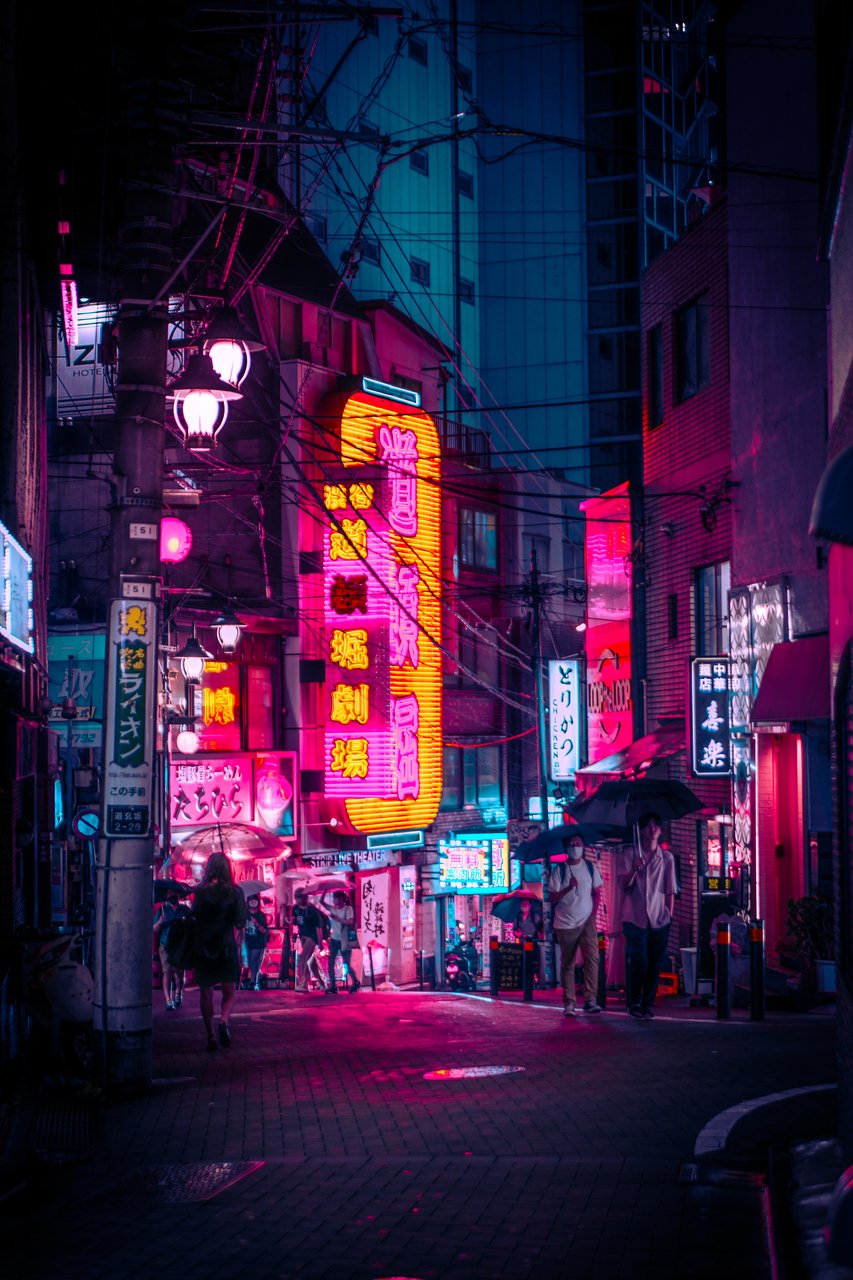
Dogenzaka is the slope running west of the station, and the streets threading off it are some of the most photographically dense in Tokyo. The neon here is different from Kabukichō — smaller buildings, more contained light, streets narrow enough that the signs on opposite sides of the road almost seem to lean toward each other. At 11pm on a Friday the energy is high without being chaotic.
The side streets off Dogenzaka are where the work gets done. Smaller izakayas, karaoke places with handwritten signs, concrete stairwells lit by a single fluorescent strip. This is the kind of material that doesn't show up in listicles. You find it by walking slowly and looking at things that aren't the main event. If you've been to Shinjuku after dark, the principle is the same — the interesting shots are one turn off the obvious route.
Center-gai and the Area Behind 109
Center-gai is a pedestrian street that runs north from the crossing, and it's worth at least one pass. The signage density is high, the crowd spills out onto the pavement, and on weekend nights it has a different energy from the rest of Shibuya — younger, louder, more chaotic. Photographically it works well with a wider lens where you're close to people and letting the scene fill the frame.
The streets directly behind Shibuya 109, on the south side, are quieter and less photographed. Single lamps casting yellow over concrete stairwells. A bar sign visible through a gap in two buildings. These are the frames that hold up longer than the wide neon shots, because there's a subject in them — not just atmosphere.
Shibuya Stream and the West Side
Shibuya Stream is a newer development along the Shibuya River — a redesigned stretch of previously culverted waterway running below the elevated Toyoko line tracks. The architecture is modern, the light is designed rather than incidental, and it doesn't look like the Tokyo you see in most photography. Worth an hour if you want images that read differently from standard Shibuya material.
The area around Daikanyama, a short walk south, is more residential and lower-key. Not night photography in the neon-heavy sense, but well-designed streets and a different visual register. If you're shooting for a couple of hours, starting at the crossing, moving through Dogenzaka and Center-gai, and ending at Shibuya Stream gives you a route with genuine variety.
Rain Makes Everything Better
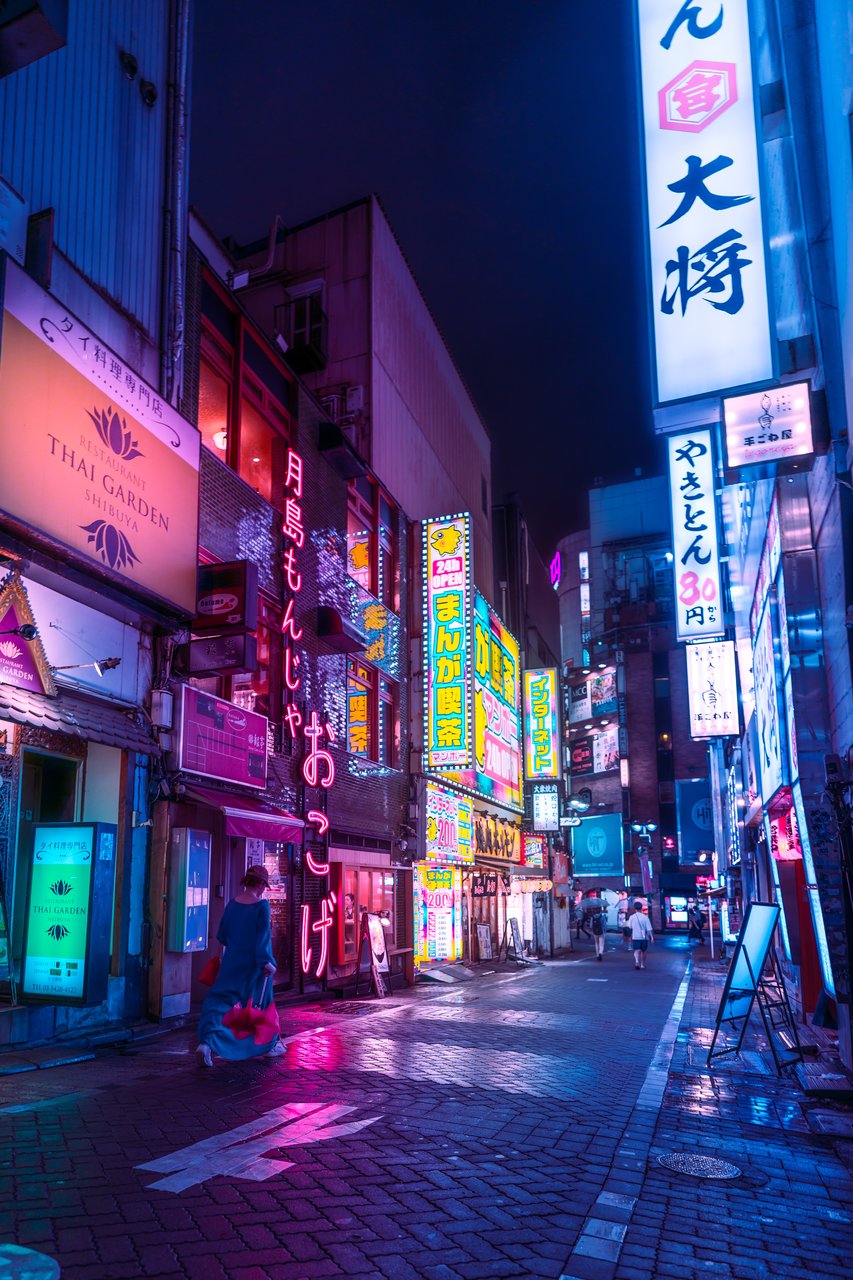
This is true everywhere in Tokyo but especially in Shibuya. Rain turns every surface into a mirror. The Scramble becomes a reflection pool. Dogenzaka's neon doubles onto the wet pavement. Even a light drizzle changes what the camera sees dramatically. If you're planning a Shibuya night shoot and it rains, don't reschedule — go. A rainy Monday night will produce better images than a clear Saturday.
Wet weather also thins the crowd slightly, which helps at the crossing. You start to get more space, cleaner separation between subjects, less visual noise in the frame.
Best Time to Shoot Shibuya After Dark
Shibuya has two distinct modes that are worth shooting. The first is the Saturday evening rush before 9pm, when the energy peaks and the streets are at full capacity — this is the version most people know and it earns its reputation. The second is weekday late nights after midnight, when the crowds thin but the light stays on, and the city shows a quieter, slightly more desolate version of itself. That second mode produces less obvious images and is underused by visiting photographers.
The dead zone — 10pm on a Tuesday, say — is honestly the least interesting time. Too quiet for the energy shot, not quiet enough for the empty-street shot. Plan for one extreme or the other.
Gear and Settings
I shoot Shibuya almost exclusively on the 50mm f/1.4 GM. At night, the fast aperture matters — you're working in mixed artificial light with constantly changing exposures, and f/1.4 gives you options without forcing ISO into territory where you lose shadow detail. The 50mm focal length also compresses the scene just enough to make the street density work in the frame.
For the crossing specifically, a longer lens is worth considering — 85mm or more lets you isolate individuals from a distance and gives you the compressed, busy background that works for that kind of shot. Wide angle at the crossing tends to produce images that feel chaotic without a clear subject.
Autofocus with subject tracking handles the crossing well. For the side streets, manual focus or zone focus can be faster when things are moving unpredictably in low light.
How Shibuya Compares to Other Tokyo Neighborhoods at Night
Shibuya and Shinjuku are the two obvious candidates for Tokyo night photography, and they're different in useful ways. Shinjuku's Kabukichō has more neon density and a more cinematic quality — it reads as the "Tokyo at night" image most people have in their head. Shibuya has more variety across a smaller area, and the Scramble gives you something no other neighborhood has. If you're only shooting one night in Tokyo, Shinjuku. If you're there for a week, both — and treat them as different problems rather than the same shot in different locations.
Want portraits with Shibuya as the backdrop?
Book a Session in Tokyo →