
The Sorayama exhibition currently at Creative Museum Tokyo is the largest retrospective of his work ever assembled, and it closes May 31. If you've been vaguely planning to go, stop planning.
Hajime Sorayama has been making chrome robots since 1978, when he painted the first one for a whisky advertisement. The Sexy Robot series followed in 1983. He designed Sony's original AIBO. Did the cover for Aerosmith's Just Push Play. His aesthetic is singular enough that "Sorayama" functions as its own noun — hyperrealistic chrome bodies rendered with an airbrush precision that makes you check twice whether you're looking at a painting or a photograph. The exhibition is titled Light, Reflection, Transparency, which is also a description of how he thinks about the practice. He's talked about spending decades trying to render things that can't technically be seen — the surface tension of polished metal, the quality of air around a chrome form. You walk through nearly 50 years of that pursuit across multiple floors in Kyobashi.
The Early Work
The first rooms cover the late 70s and 80s. The original 1978 whisky ad illustration that started everything is here — smaller than you'd expect, worked in gouache and airbrush. Seeing the actual object for the first time is useful. The reproduction you've encountered is fine, but standing in front of the original makes clear that someone physically sat down and painted this into existence, stroke by stroke. That takes a moment to absorb, especially knowing what the image eventually became.
From there, the rooms open into an expanding range of robotic figures: humanoids, animals, fantastical creatures, all rendered with the same obsessive precision. The large-scale canvases from recent years are in here too, and they demonstrate that the technical obsession hasn't slowed. If anything it's intensified.
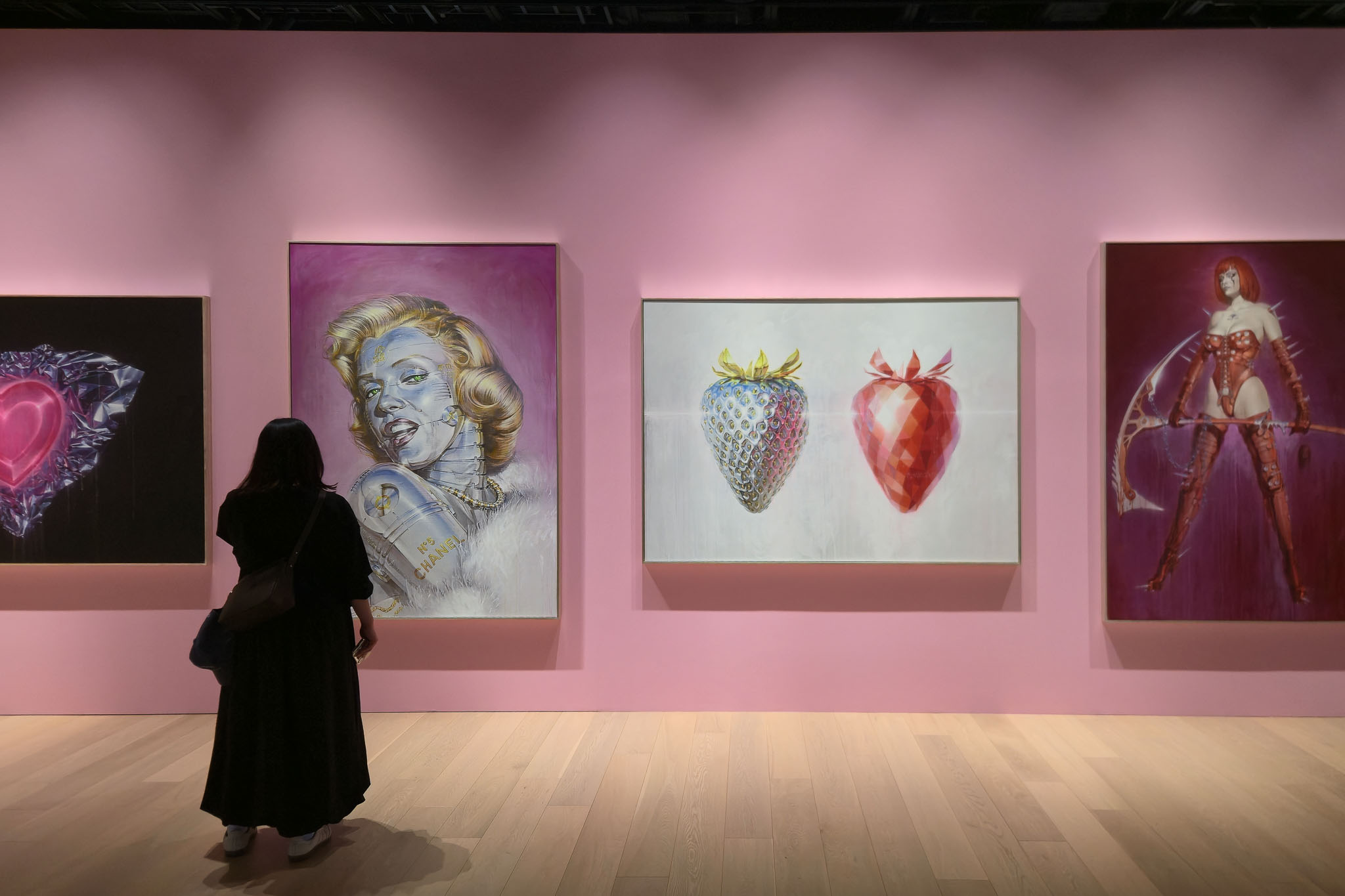
The Pink Room
One room breaks from the expected palette entirely — pale pink walls, softer lighting, a completely different mood. The paintings here are not the silver-and-chrome work Sorayama is known for. There's a chrome Marilyn Monroe, a pair of gem-cut strawberries rendered with the same hyperrealism he applies to everything else, a female warrior figure in deep red and purple armor. Still technically extraordinary, but more playful than the robot work. It's a side of his practice that gets less coverage and is worth slowing down in. The room felt like a different conversation happening within the same exhibition.
The Sculptures
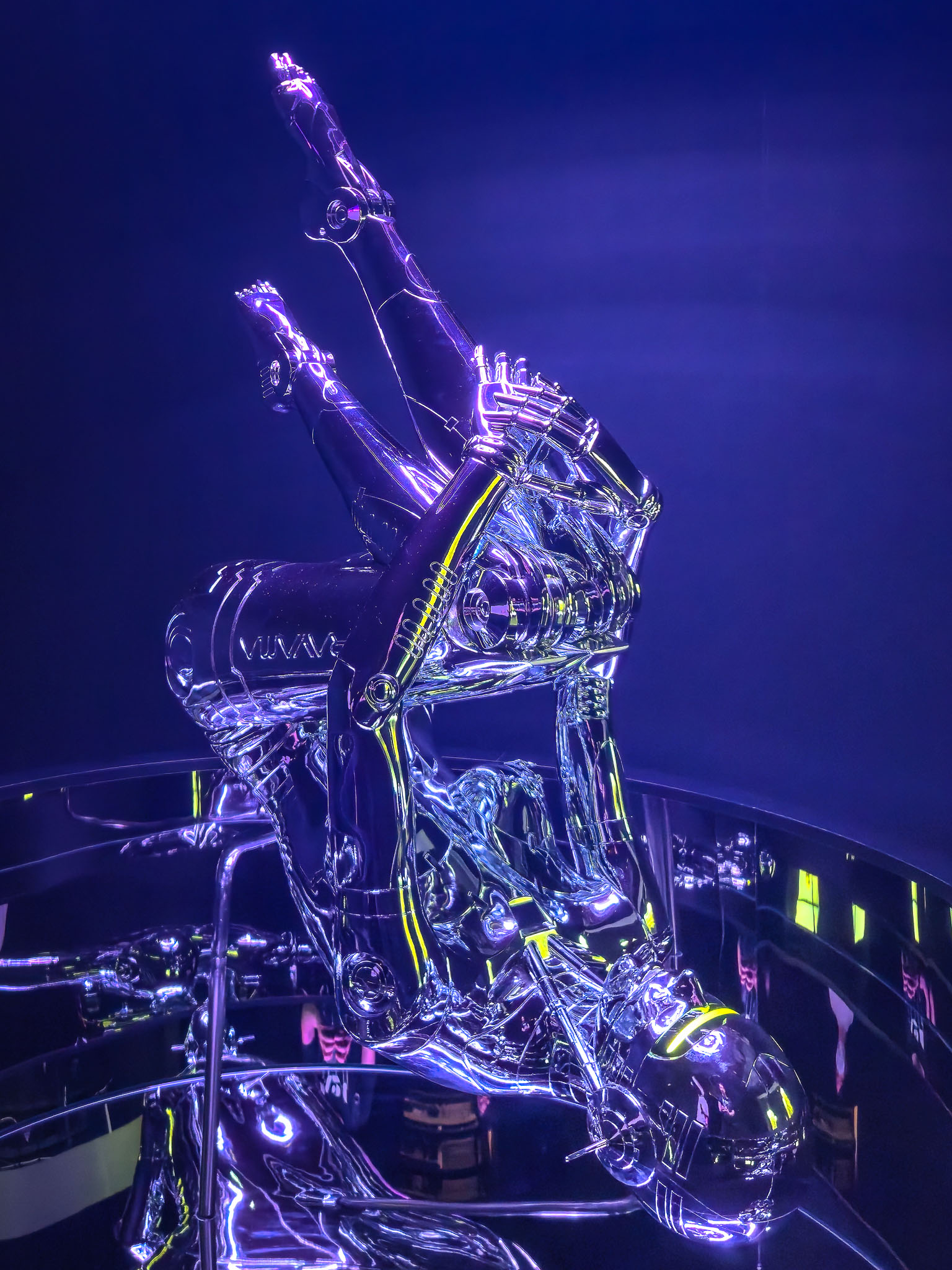
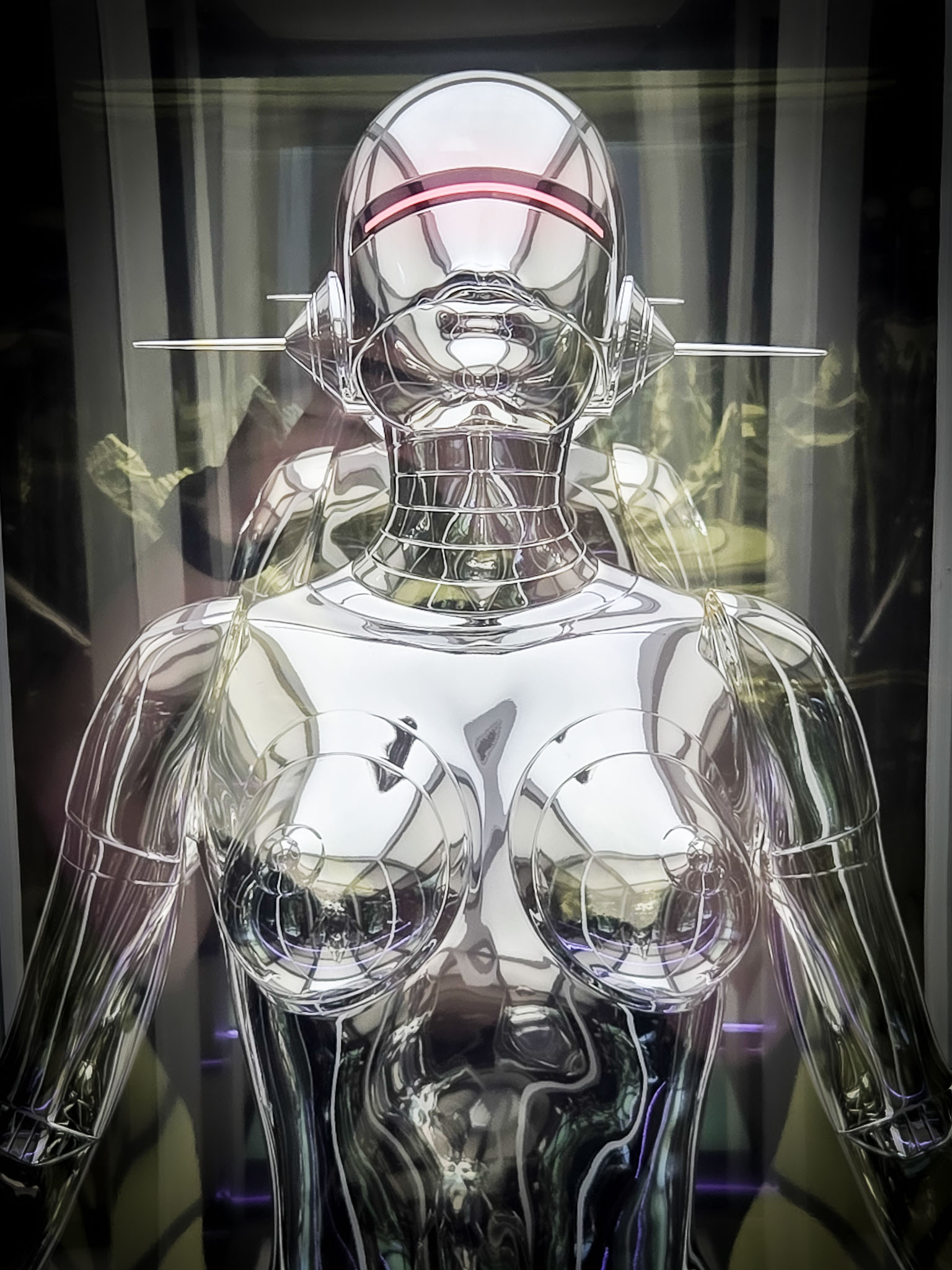
The sculptural section is where the exhibition earns its floor space. There's a large chrome robot under purple and neon-yellow lighting, twisted into a dynamic, almost violent pose — frozen mid-movement. The chrome picks up the room's colored light differently depending on where you're standing. Photographs of it don't resolve properly, which feels appropriate. A body of work about surfaces that can't technically be captured on camera has at least one piece that refuses to be captured on camera. You need to be in the room.
The Sexy Robot sculptures in their display cases are what most people come for. Standing in front of one, face to face, the scale and the surface finish are both different from any reproduction. The visor, the chrome, the way ambient light breaks across the form — these are images you've seen hundreds of times and they still hold when you're standing six inches from the actual thing. Not everything does.
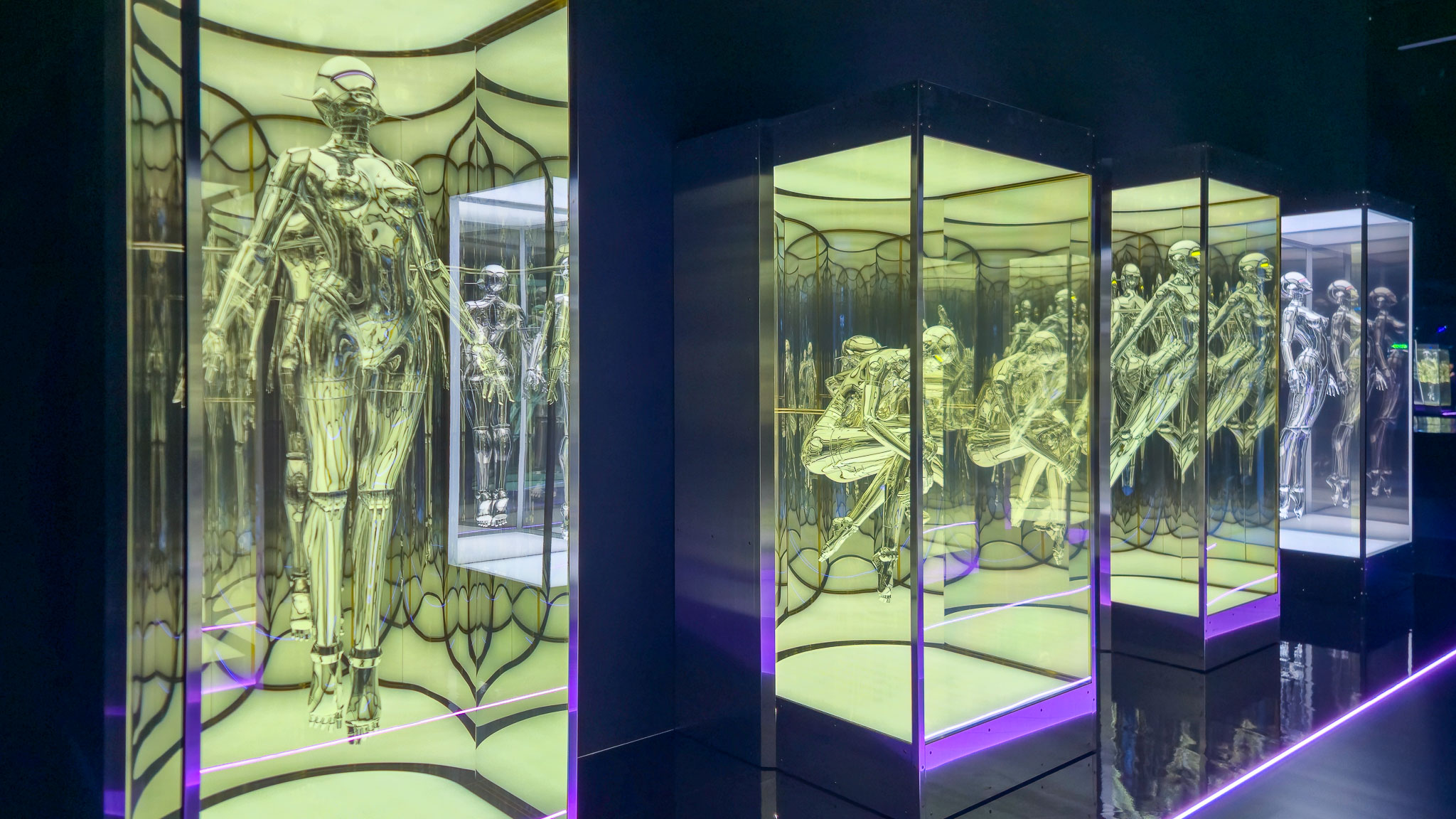
One of the better installations is a row of glass display cases in a dark room, each backlit in warm yellow-green with chrome robot figures posed inside. The patterned glass references Art Nouveau — not an obvious Sorayama touchstone, but it works more than you'd expect. The overall effect is like jewelry for a civilization that doesn't exist yet. The purple floor lighting keeps the whole thing cinematic rather than clinical. I spent more time in this room than any other.
The Studio
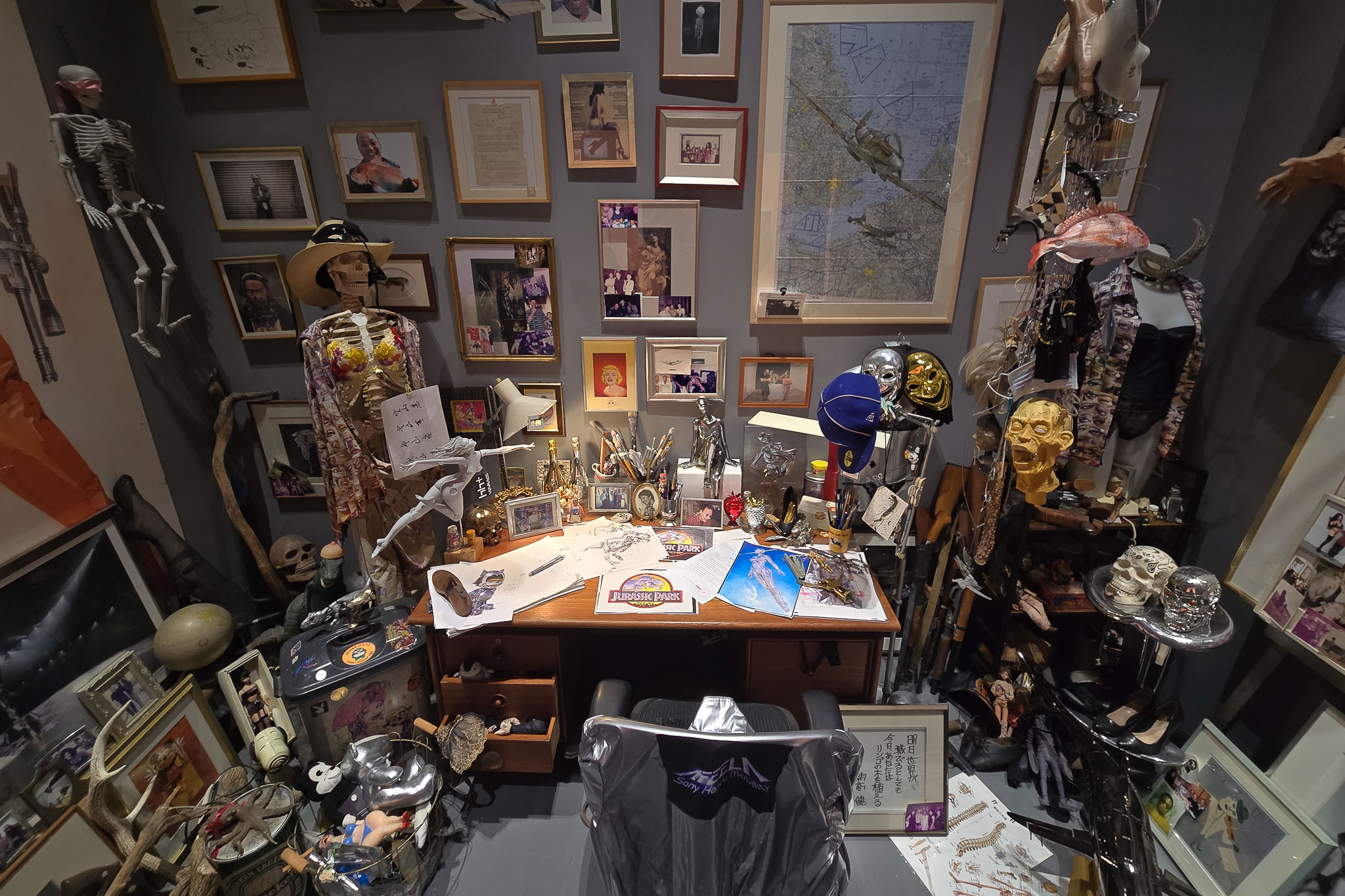
There's a recreation of Sorayama's studio — a dense, cluttered tableau of models, maquettes, photographs, reference materials, and 50 years of accumulated objects. Most artist studio recreations feel staged and tidy in a way the actual studio never was. This one reads as lived-in. It clarifies something about the work: the physical models he builds to understand reflective surfaces before painting them, the reference images pinned everywhere, the sheer material volume of a long practice compressed into one room. People move through it quickly. They shouldn't.
Newer Work and Collaborations
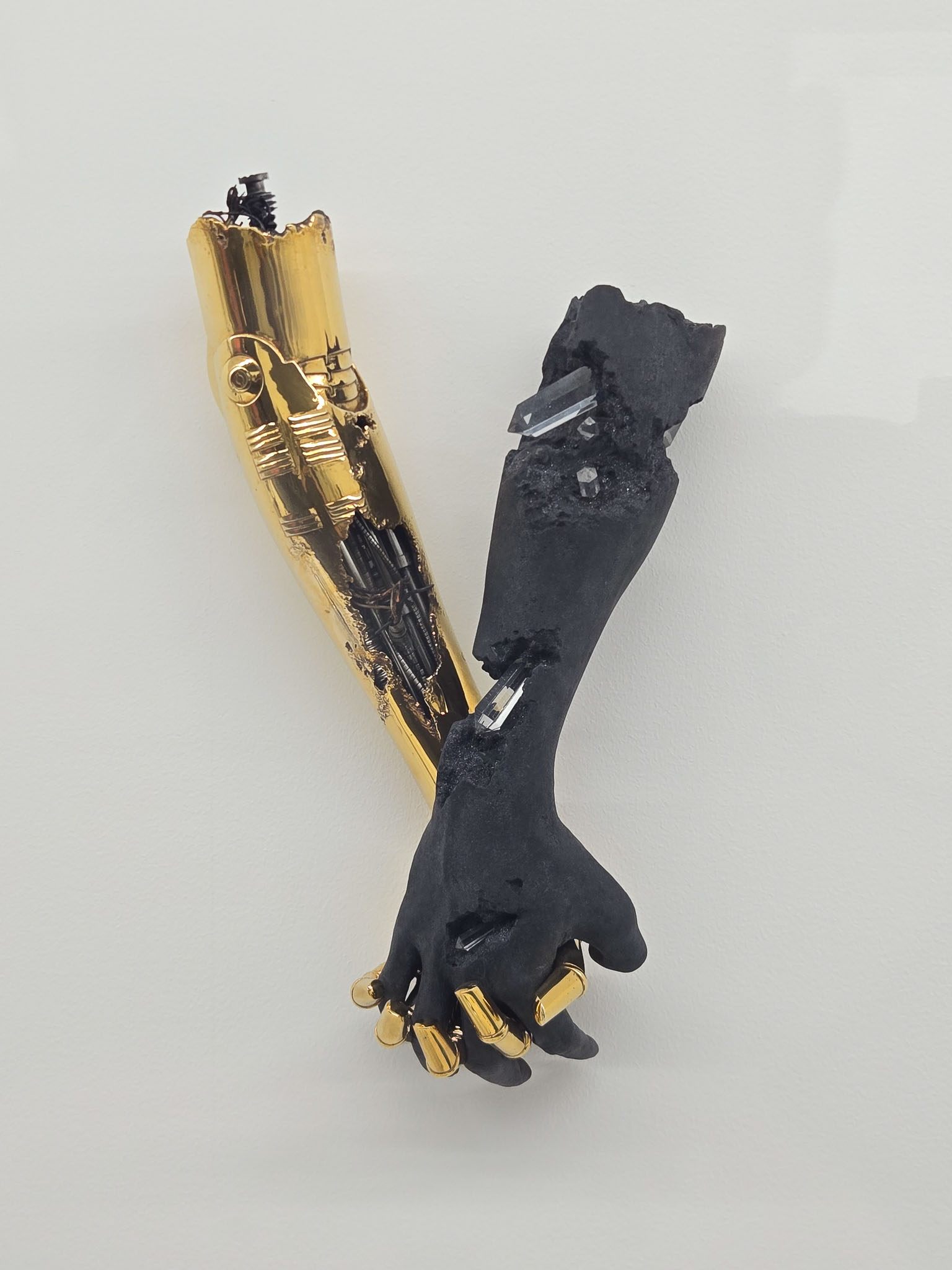
Newer sculptural works show where the practice has been moving recently. Two robotic arms mounted on a white wall — one gold chrome with exposed mechanical detail, one matte black with crystals embedded in the surface — are formally interesting in a way that's distinct from the earlier work. Less invested in pure surface illusion, more interested in material contrast and what happens when the chrome ideal degrades or transforms. The Remastered Series is similar in spirit: archival works reprinted in high resolution and then reworked by hand. He's not just maintaining the legacy.
The AIBO room, with original design drawings for Sony's entertainment robot dog, is worth finding — it's a specific moment where his aesthetic moved from art into industrial design and reached millions of people who'd never heard his name. The Floating Through Space video installation, based on his long-running Space Traveler motif, is the most immersive piece in the building and disorienting in a way that earns the description. There's a collaboration section with Masamune Shirow — the creator of Ghost in the Shell — which is exactly as maximally dense as you'd expect from two people who've spent decades thinking about chrome bodies and the boundaries between the organic and the mechanical. A highlight unique to this Tokyo edition is the public debut of the AFEELA prototype tuned by Sorayama in collaboration with Sony Honda Mobility, connecting directly back to the AIBO lineage in a way that feels inevitable rather than promotional.
Practical Notes
Plan two hours minimum. The building is in Kyobashi — a short walk from Ginza-itchome station, easy from Tokyo Station. Weekdays are better for the darker installations; patience is harder when a crowd is forming behind you. Extended hours until 20:00 on Fridays and Saturdays if that works better.
The exhibition closes May 31. That's the information. Everything else you can figure out when you get there.
Shooting Tokyo and want portraits that look like the city feels?
Book a Session in Tokyo →