
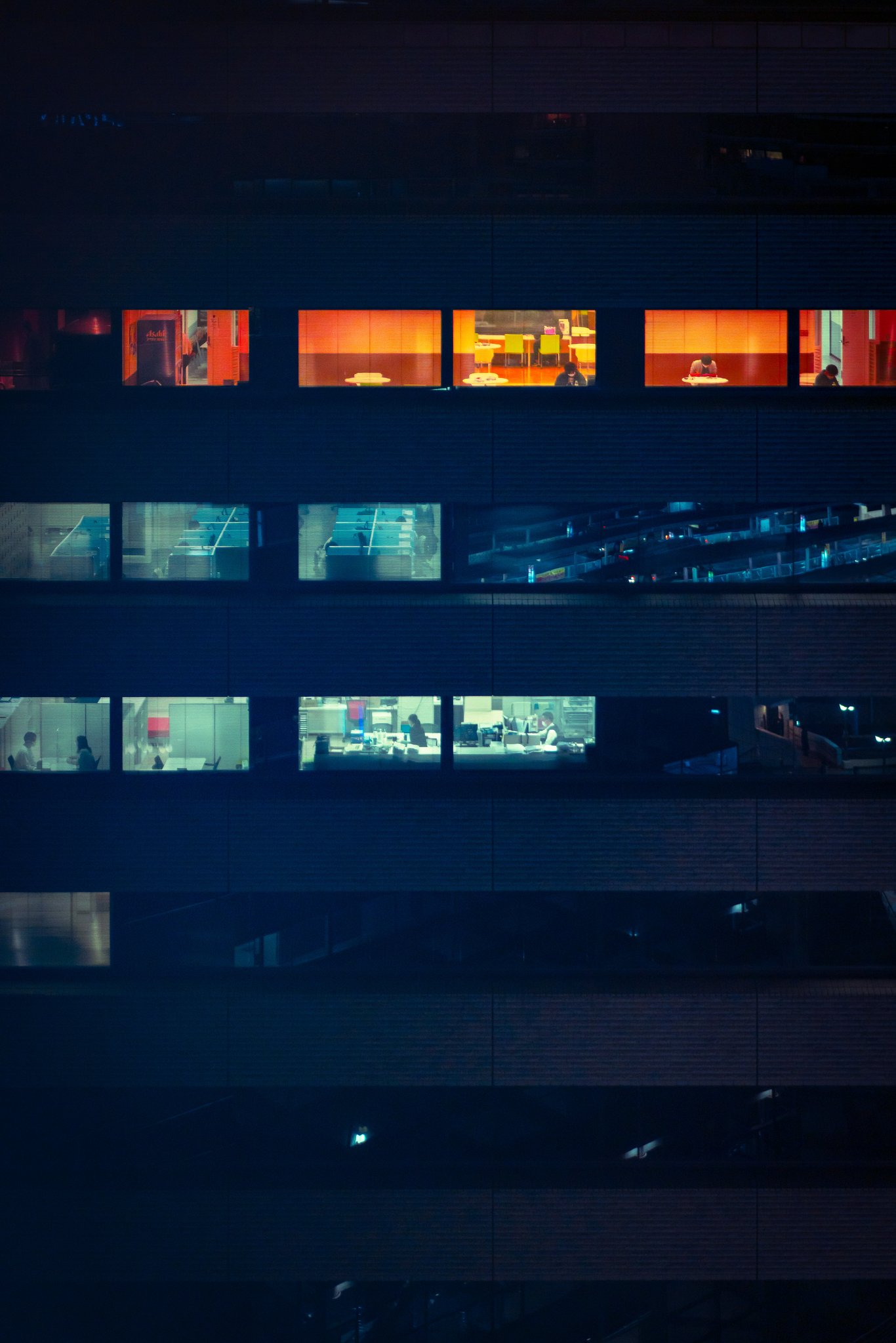
I've been shooting Tokyo at midnight since I moved here in 2022, and the honest reason I started was practical: I was new to the city, working on other things during the day, and the night was when I had time. I didn't have a theory about it. I just went out late because that's when I could. What I found after a few months of this was that the city after midnight is photographically different from the city at 9pm in ways I hadn't anticipated — and different in ways that actually suit the kind of images I want to make.
What Changes After the Last Train
The trains stop between midnight and 1am depending on the line, and when they do, something shifts. The category of person on the street changes. The salaryman heading home after a work dinner disappears. The tourist on a schedule disappears. What remains is a more self-selected group: people who chose to be out this late, which means people in the middle of something — a night that's still going, a conversation they don't want to end, a bar they found that turned out to be good. The energy on the street after last train is different, and that difference shows in photographs.
The light doesn't change much. This is the thing that surprises people who haven't spent much time in Tokyo's main neighborhoods after midnight — the neon stays on. In Shinjuku's Kabukichō, the signs run until 3 or 4am. Convenience stores light the streets all night. The visual environment at 2am is nearly identical to 10pm in terms of the light you're working with, which means this isn't a "push the ISO and hope" situation. You have the same light, a smaller and more interesting crowd, and more space to work in.
The Neighborhoods That Work and the Ones That Don't
Not everywhere in Tokyo is worth staying out for. Some neighborhoods hit a kind of dead zone after last train where there's neither the energy of the evening nor the emptiness of deep night — just quiet streets with nothing particular happening. Midnight photography rewards the areas that stay genuinely active late, and those are more specific than you'd think.
Shinjuku works until at least 3am on weekends, later on the main strip. The entertainment district doesn't wind down at midnight — it's still moving, just differently. Akihabara has a specific late-night character: the games centers stay open past midnight, the convenience stores are busy, and the area attracts a different crowd than the one that's there at 8pm. Shibuya has two modes — the peak energy before midnight and a quieter, stranger version after. Both are worth shooting. The post-midnight version is less documented and more interesting to me.
Neighborhoods I'd leave before midnight: Asakusa, most of east Tokyo, residential areas in general. The photographic material there is in the daytime or early evening. Staying late in Asakusa gets you empty streets under temple lights, which is beautiful but requires a specific intention. For reactive street photography, it's the wrong place after midnight.
What You Find That Doesn't Exist Earlier
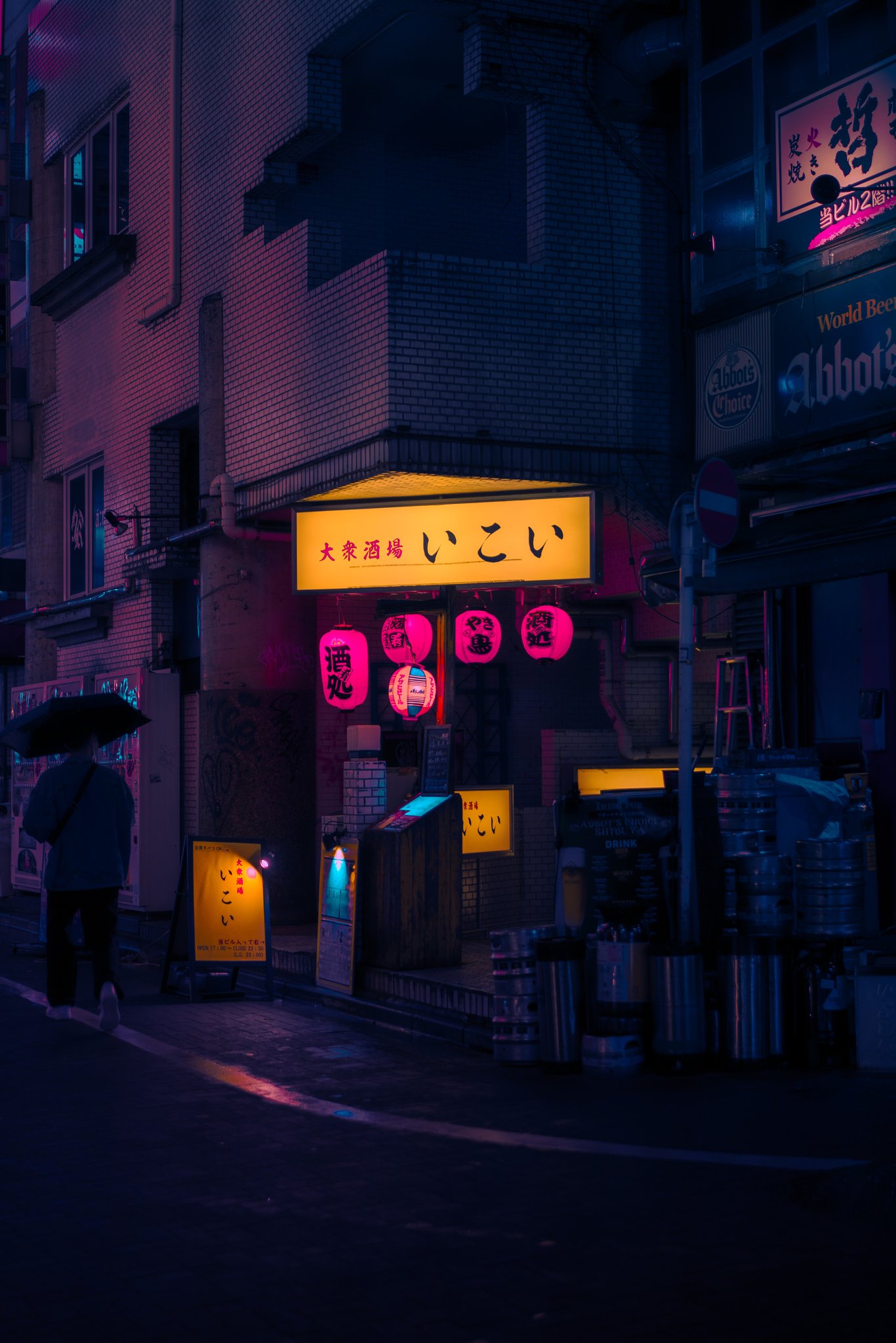
There are things that happen after midnight in Tokyo that simply aren't available at 9pm. The street food vendors and yakitori stands that set up outside certain stations do their best business between 11pm and 2am. The small bars — the ones with five seats and a handwritten sign that you'd walk past ten times before noticing — are fullest and loudest at 1am. The construction work that's legally prohibited during the day runs overnight on major projects, which means there are sections of the city where you have workers, bright work lights, and industrial equipment operating in the middle of streets that are otherwise empty. That's a specific visual situation that doesn't exist in daytime Tokyo.
There's also a quieter reward, which is space. By 2am even in Kabukichō you can get a frame without fifteen people photobombing it if you wait 30 seconds. The famous Shinjuku Golden Gai alley, which is impassable with tourists at 8pm, opens up enough after midnight to actually move through and shoot. The scramble crossing in Shibuya — which is nearly impossible to frame cleanly at peak hour — thins out enough that you can get single figures cutting across it against the blur of the few remaining pedestrians. The images you make at 2am in these spaces are structurally different from the ones you make at 9pm, even in identical weather and light.
The Logistics of Missing the Last Train
The practical problem is that once the trains stop, your options for getting home are taxis or walking. Taxis in Tokyo are metered, reliable, and expensive by the standards of the rest of Japan — cheaper than most European cities, but not pocket change. A 20-minute ride from Shinjuku to a nearby neighborhood is roughly ¥1,500–¥2,500. Budget for it if you're planning to stay out.
Walking is more appealing than it sounds. Tokyo's streets are safe at any hour — I've walked home from shoots at 4am without a moment of concern in four years — and the walk itself is often productive. Some of my best frames have come from streets I passed through on the way home from somewhere else, at an hour when I wasn't expecting to find anything worth photographing. Give yourself an extra 20 minutes on the walk and let it be part of the shoot.
The first trains start again around 5am. If you stay out until then, you can ride home in near-empty carriages with the people who are starting early shifts rather than ending late nights. That transition — the 5am train, the light starting to change, the city switching over from night to day — is its own photographic moment, and one that very few people are awake to see.
Camera Settings After Midnight
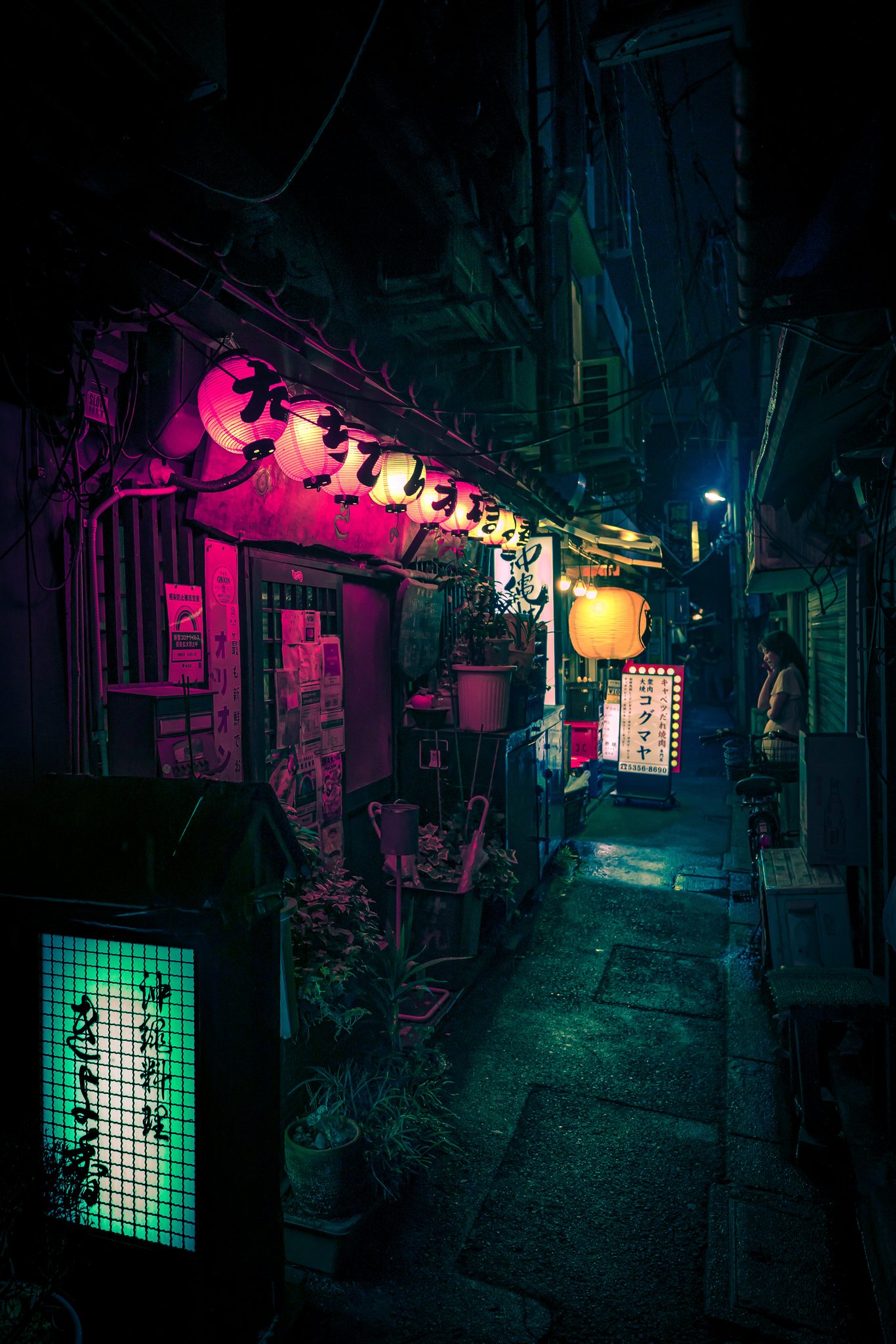
The technical considerations for midnight shooting are the same as for any low-light street photography in Tokyo, but with more variance. You're moving between well-lit main streets and genuinely dark side alleys, sometimes within a few steps. I keep auto ISO running with a ceiling at 12800, minimum shutter at 1/100, and aperture at f/1.4. When I turn into a dark alley, the camera compensates automatically. When I'm back on the main strip, it pulls ISO back down.
The missed shots at this hour are almost always motion blur rather than focus failures — someone moving faster than expected through a dark patch where the shutter dragged below 1/100. If you want to shoot in genuinely dark alleys, push the minimum shutter to 1/160 or higher and let ISO go where it needs to. Grain at high ISO is recoverable in post to a degree; motion blur on a subject's face is not.
Why It's Worth It
I don't have a philosophical argument for midnight photography. I don't think it's inherently more authentic or more interesting than shooting at 8pm. What I know from doing it regularly for four years is that it produces images that look different from the images everyone else brings home from Tokyo, and different in ways that I care about. Less crowded. More specific. Quieter. The city at 2am is harder to find in a Google image search, which probably means it's more worth photographing.
Stay out past the last train at least once when you're here. The city is still there. The light is still on. Most people just don't know it.
Want to shoot Tokyo after midnight with someone who knows the streets?
Book a Session in Tokyo →