
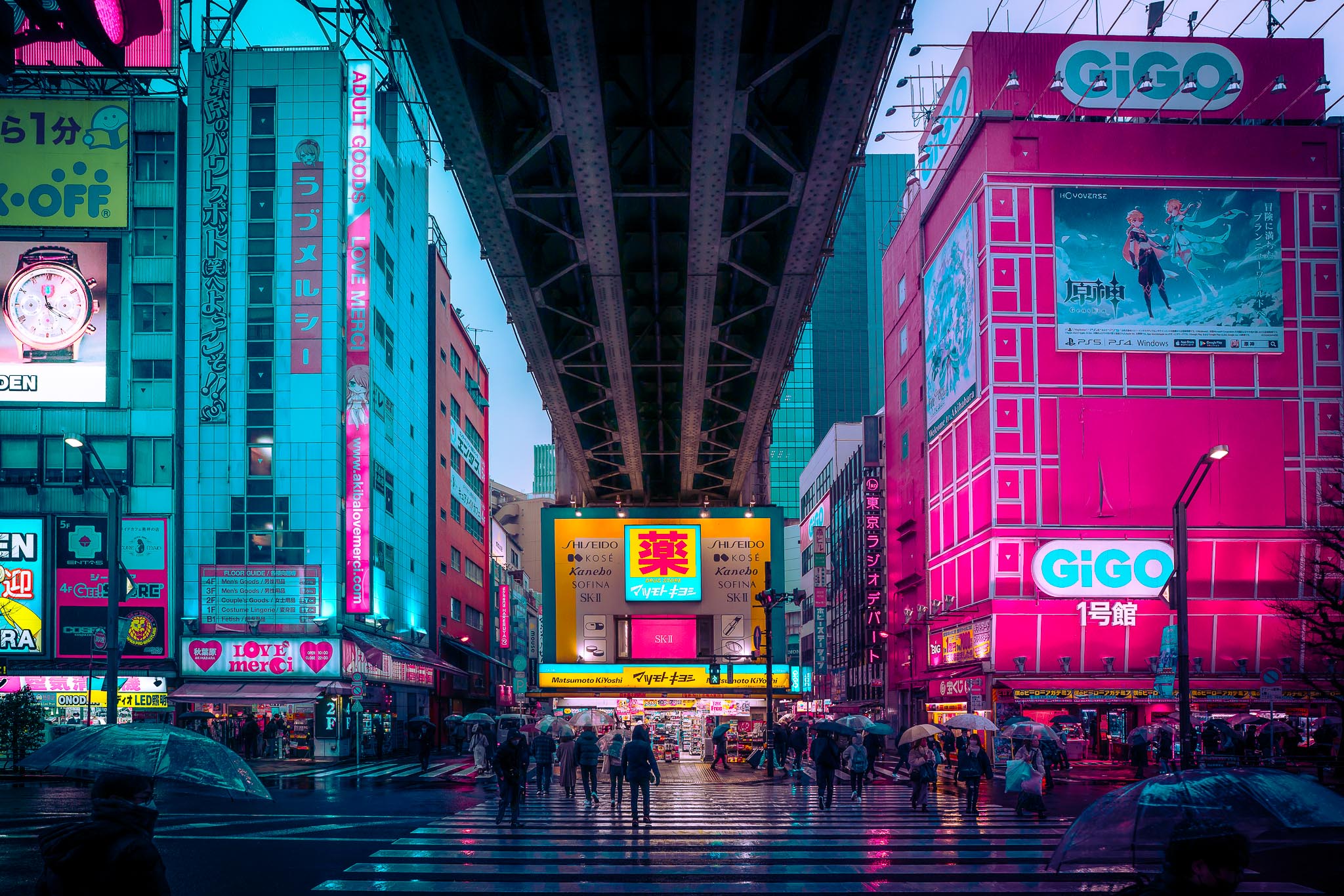
Akihabara night photography is harder than it looks, and it looks hard. The neighbourhood is one of the most visually intense environments in Tokyo — neon signage competing from every surface, anime billboards the size of buildings, electronics shops with illuminated displays running floor to ceiling — and that density works against the photographer in specific ways. Too much information in the frame produces images that read as chaos rather than composition. The viewer's eye has nowhere to rest. The shot that felt impressive in person lands flat on a screen because impressive and photogenic are not the same thing.
That said, Akihabara is worth shooting. The visual material is genuinely unlike anywhere else in the city. The problem is learnable. Here's how to approach it.
Why the Main Street Doesn't Work and What to Do Instead
Chuo-dori, the main street running through Akihabara, is where most photographers set up — it's the obvious shot, the widest street, the most density. The problem is that wide-angle shots on Chuo-dori tend to produce images where everything is equally important, which means nothing is. The electronics signs, the anime billboards, the traffic, the pedestrians — everything competes at the same volume and the frame has no hierarchy.
The fix is to stop trying to capture "Akihabara" as a concept and start looking for a single element worth isolating. One storefront with the right light. One figure against one sign. The rest of the street as compressed background rather than co-subject. A longer focal length helps — 85mm or 135mm pulls elements together and reduces the visual field, which forces a decision about what the image is actually about.
The Elevated Tracks: Akihabara's Best Compositional Tool
The JR Yamanote and Keihin-Tohoku lines run on elevated tracks through the heart of Akihabara, and those tracks are the neighbourhood's most useful compositional element for photography. From the street below, looking up the main drag toward the crossing point, the underside of the elevated structure frames the chaos beneath it and gives the image an architecture it wouldn't otherwise have. The tracks create a ceiling. The neon fills the space underneath. The crowd moves through the middle.
The intersection directly below the tracks — where Chuo-dori passes under the elevated rail — is the best single vantage point in Akihabara. From here, looking south, you get the framing of the elevated structure above, the neon density on both sides, and enough depth for the image to have a clear foreground, midground, and background. This is the frame that works. Getting it requires patience — waiting for the right figure to cross into the right position — but the setup is there every night.
Rain Is the Variable That Changes Everything
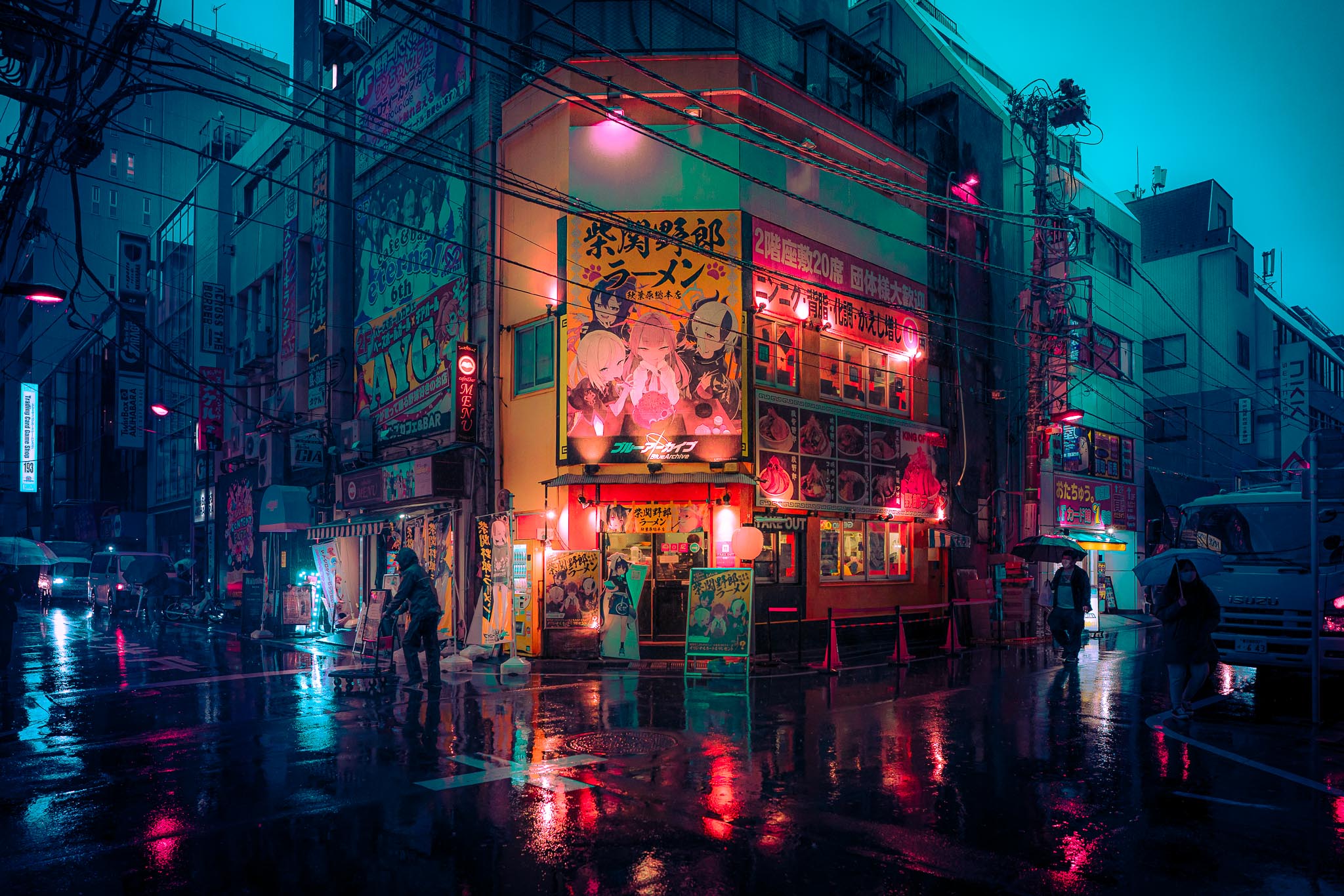
Akihabara in the rain is a fundamentally different photography subject from Akihabara on a dry night. The pavement on Chuo-dori and the surrounding streets becomes a mirror that reflects every illuminated sign above it — and since those signs are numerous and varied in colour, the reflections are complex and visually dense in a way that works photographically rather than against it. The problem of "too much information" becomes an asset when that information is doubled and abstracted in wet pavement.
Ground-level shooting — camera close to the pavement, shooting upward into the reflections — produces images that look deliberately composed because the geometry of the reflections gives the frame structure. The chaos above becomes ordered below because water is a more consistent surface than neon-lit buildings. If you're planning an Akihabara shoot and you have a choice of nights, choose the rainy one without hesitation.
The Side Streets: Where Akihabara Gets Manageable
The streets running east and west off Chuo-dori are quieter in neon terms and more workable for conventional street photography. The electronics shops give way to smaller restaurants, component stores, older buildings with different signage. The visual noise drops significantly. A ramen shop on a corner with a single large illuminated sign, reflections in the wet street, a figure passing — this is a composed frame rather than a documentation of chaos.
The area around the Akihabara UDX building and the electric town exit of the station has a slightly more mixed character than the main drag — some of the older Akihabara architecture alongside newer development — which gives the streets a more layered visual quality. Worth exploring if the main street is frustrating you.
How Akihabara Compares to Other Neon Districts
The obvious comparison is Shinjuku's Kabukichō, which is also neon-dense but operates differently. Kabukichō's neon is concentrated in a relatively small area and has a cinematic quality — the signs are large but there's a hierarchy to them, and the streets are narrow enough to create compression. Akihabara's neon is distributed across a wider area and competes more evenly, which is what makes it harder to shoot. Shibuya is a third model — less neon density overall, more concentrated at the crossing.
Akihabara is the most challenging of the three and produces the most distinctive images when it works. The key is accepting that you won't capture the whole neighbourhood in a single frame, finding the one element worth isolating, and waiting for the conditions — rain, the right light, the right person in the right position — to align.
Gear Notes for Akihabara
The 50mm is the starting point — it's a usable focal length in the crowd and gives you enough separation from the subject to compose without being in people's faces. For the elevated track shot, moving to 85mm or 135mm is worth it. For ground-level rain reflections, a wide-angle — 20mm or 24mm — gets more of the pavement in frame and makes the reflections the dominant element. I carry two lenses to Akihabara more than anywhere else in the city because the different approaches require different tools.
Weather sealing matters here if you're shooting in rain, which you should be. The Sony A7R IV handles it without issues. More importantly: a rain cover for your bag, and a microfibre cloth for the front element. Rain on a lens in Akihabara with neon behind it produces interesting effects but rarely the effect you want.
When to Go
Evening from around 6pm to 10pm is the peak window — the shops are still open and lit, the crowds are active, and the light balance is at its best. After 10pm the electronics shops close progressively and the character shifts — fewer browsers, more people heading to the eating and drinking options around the station. Both windows are worth shooting, they're just different subjects.
Rainy weekday evenings are the ideal conditions. Weekend rain draws larger crowds which adds compositional complexity — more people in frame, harder to isolate. A rainy Tuesday at 8pm is the version of Akihabara that works hardest for the photographer.
Want portraits in Tokyo's most visually intense neighbourhood?
Book a Session in Tokyo →