
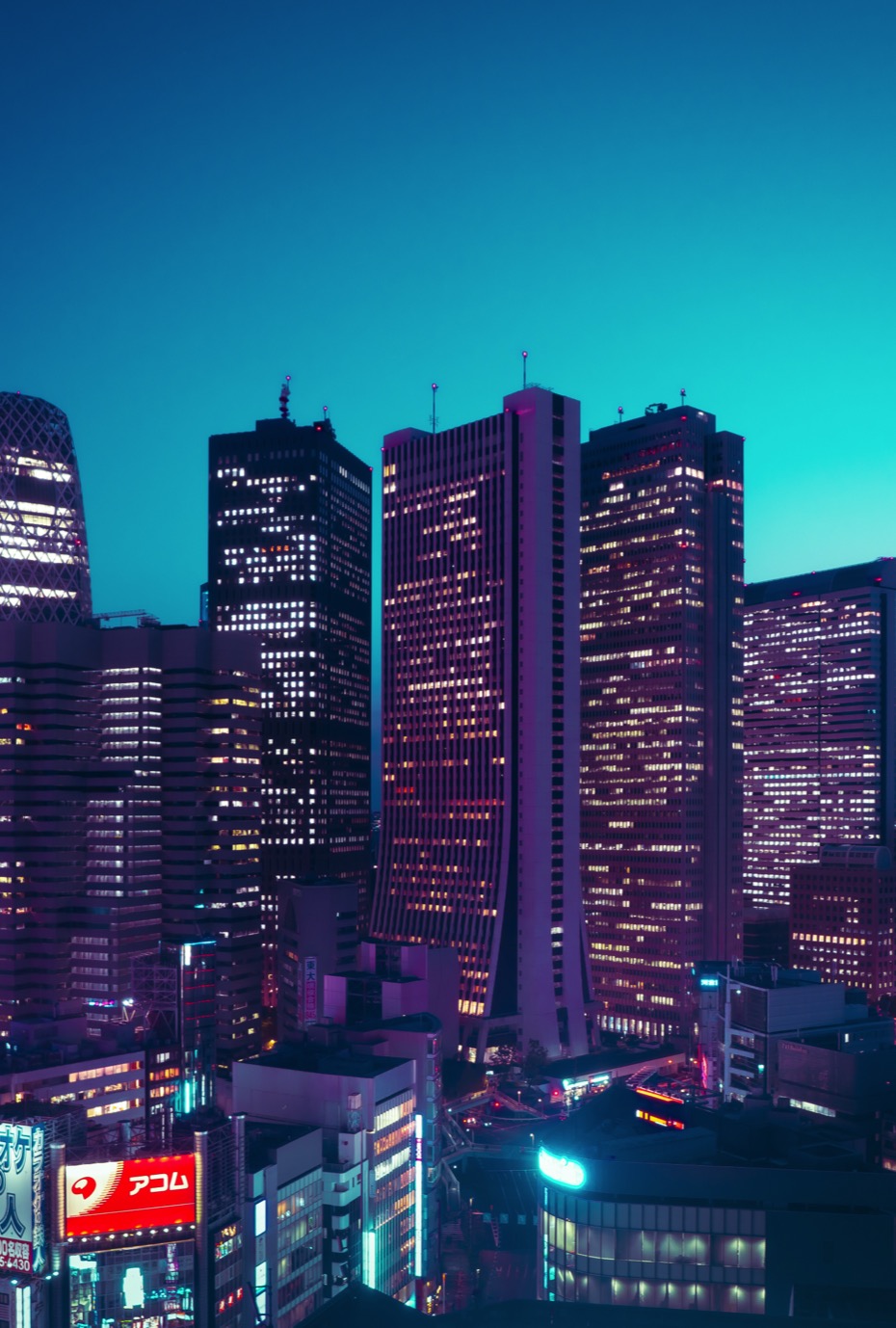
Every photographer doing Japan eventually lands on this question. Tokyo is enormous, endlessly photographed, and the city most people have in mind when they picture Japan at night. Osaka is smaller, louder, more chaotic in the ways that matter photographically, and home to a canal that looks like nothing else in the country. I've shot both cities extensively and I have a real answer — but the answer has conditions, so here's the full version.
What Tokyo Gives You
Tokyo's advantage is depth. The city is so large and so visually dense that you could shoot it for a year and not run out of material. Shinjuku alone has more photographable square footage than most entire cities. The neighborhoods are distinct from each other — Akihabara is nothing like Asakusa is nothing like Shimokitazawa — which means within a single trip you can move between completely different visual registers without taking a shinkansen.
The light in Tokyo's main entertainment districts is also hard to beat. Kabukichō is the densest concentration of neon signage in the world. The Shibuya Scramble at night is a legitimate photographic phenomenon that earns its reputation. When it rains, Tokyo's wet streets produce reflections that look like film production design — because a lot of actual film production design has been based on photographs of exactly this.
The city is also easy to navigate and generally safe at any hour, which means you can concentrate on shooting rather than logistics. This matters more than it sounds. When you're not thinking about where you are or whether you should be there, you shoot better.
What Osaka Gives You
Osaka gives you something Tokyo can't — a different relationship between the photographer and the subject. Osaka people are more openly expressive and more likely to interact with you, which changes the energy of the street. The city has a reputation for being louder and more direct than Tokyo, and that reputation is accurate in a way that's useful for street photography. People are more likely to notice you, react to you, play to the camera or push back — all of which creates friction that can be productive.
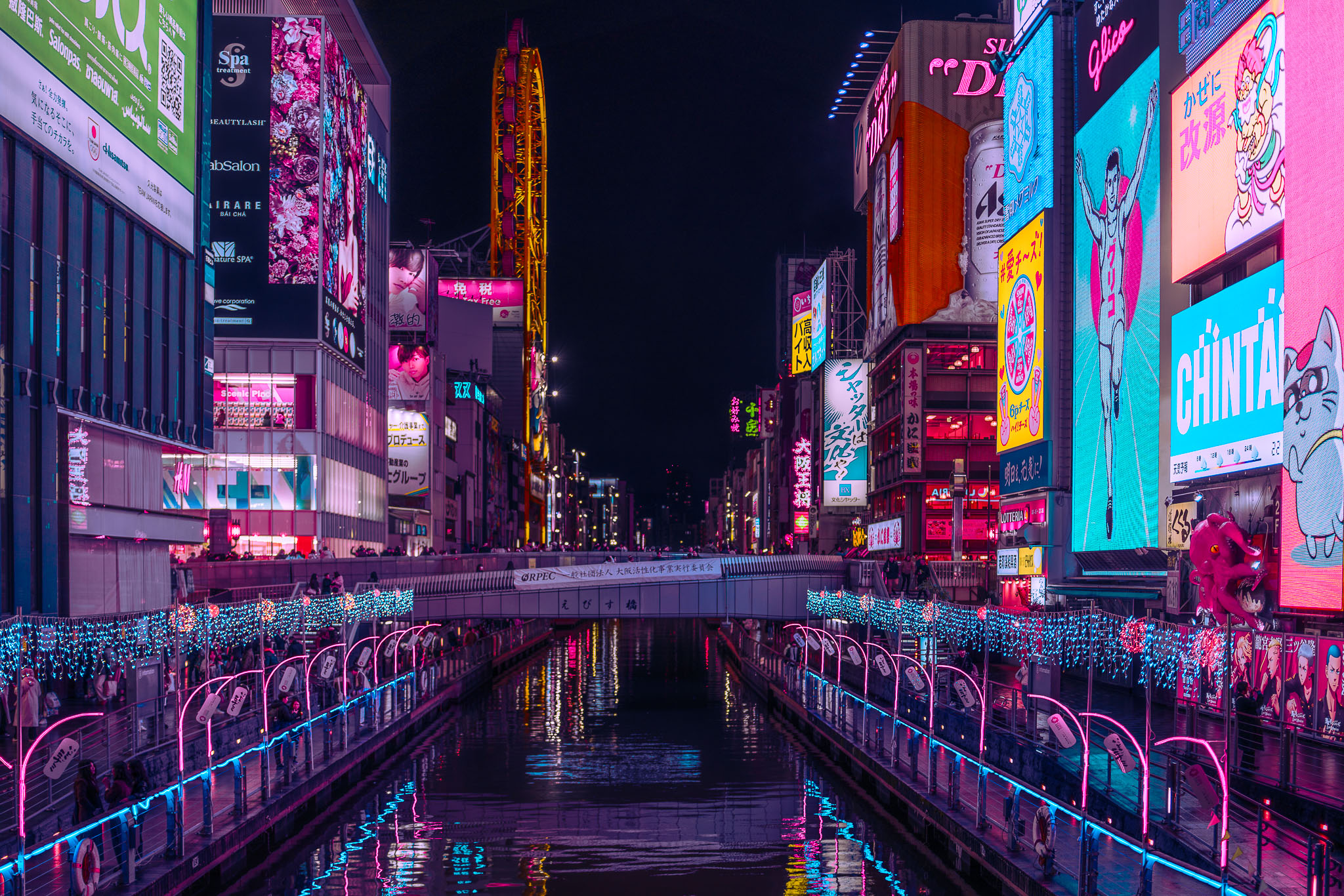
Dotonbori is the obvious anchor. The canal at night, with the Glico running man sign and the dense advertising stacked above the water, is a legitimate icon — not the kind of landmark you photograph once and ignore, but one that rewards different angles, different times of night, different weather. The reflection of the canal signs on the water when the surface is calm is one of the better naturally occurring compositions in Japanese photography. You don't have to work hard to get something there. You do have to work hard to get something that doesn't look like everyone else's shot of it.
The area around Namba and Shinsaibashi, and the covered arcade of Dotonbori itself, is compressed in a way that produces strong frames quickly. The density per block in central Osaka is higher than most of Tokyo — which means a two-hour walk produces more concentrated material than a similar walk in Tokyo, where the interesting areas are further apart.
Light: Tokyo Wins, Mostly
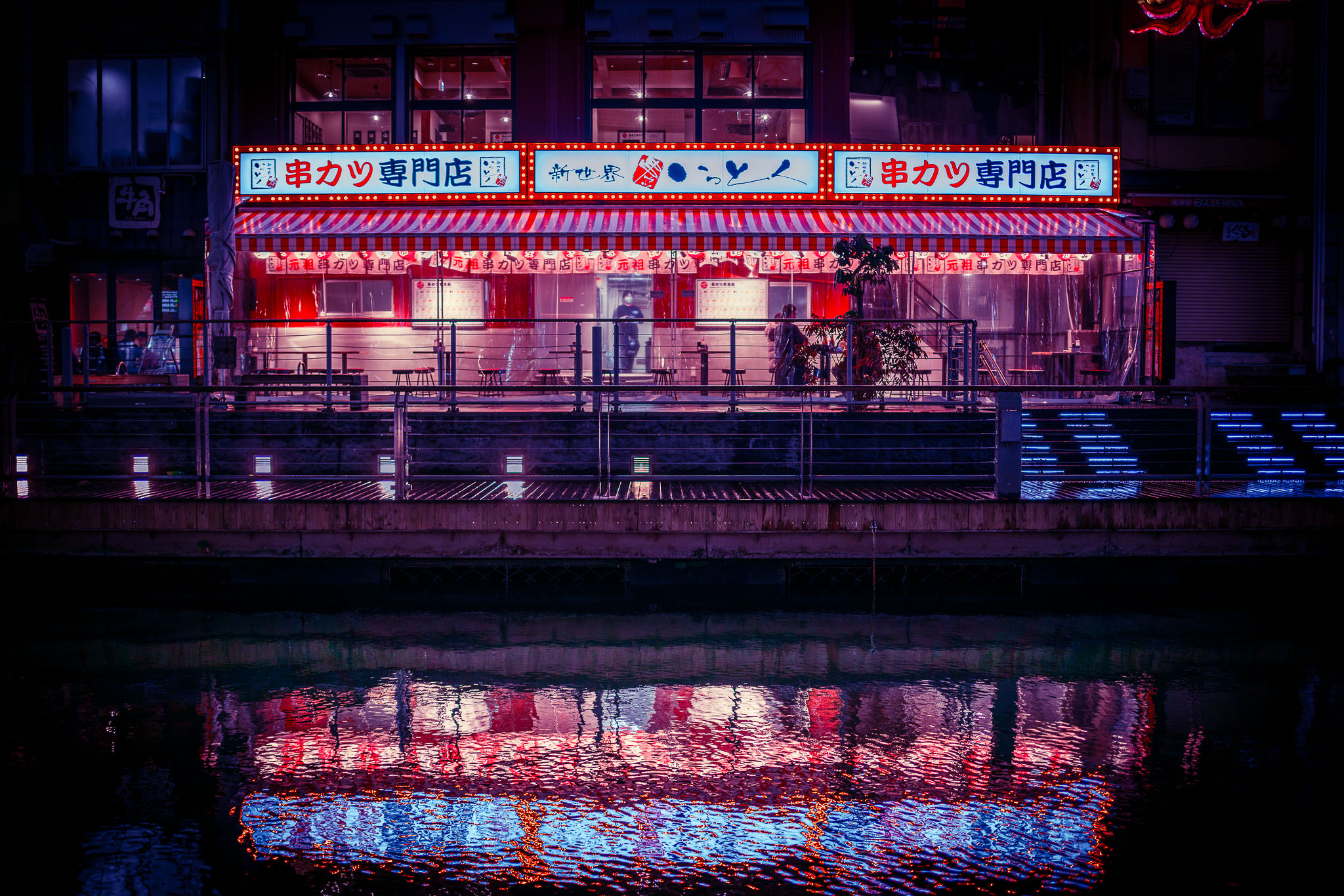
For pure quantity and variety of artificial light, Tokyo is ahead. The neon density in Shinjuku and Akihabara has no direct equivalent in Osaka. Dotonbori is spectacular but it's concentrated in a small area; once you move away from the canal the light drops off more quickly than it does in central Tokyo. If light is your primary interest — if you're shooting for the neon reflections and the color mixing and the wet-pavement effects — Tokyo gives you more to work with over more area.
Osaka compensates with a different kind of visual interest: the people. The canal scenes in Osaka work partly because the crowd at Dotonbori at 10pm on a Friday is genuinely dense and genuinely engaged with the environment in a way that produces candid moments you're not going to manufacture.
Energy: Osaka Wins
Tokyo at night is busy but controlled. The social code in Tokyo keeps public behavior within a narrower range than most cities — people are loud in the right places, quiet in the wrong ones, and generally moving with purpose from one place to another. This produces a certain kind of street photography: precise, cinematic, composed. It rewards patience and positioning. You find a frame and wait for the right person to walk into it.
Osaka is less controlled. People linger. They spill out of izakayas into the street. They eat while walking (which is considered rude in Tokyo — Osaka mostly doesn't care). The energy is more spontaneous and it produces a different kind of street photography: looser, more reactive, more personality-driven. Neither approach is better. They produce different images and different approaches to the work.
Where to Stay in Each City
In Tokyo, I'd put you in Shinjuku — close to the most photographically productive area and connected to everything else via the Yamanote Line. Hotels near Shinjuku range from budget business hotels to larger chain properties, all walkable to the east exit and Kabukichō.
In Osaka, Namba or Shinsaibashi is the equivalent. Walking distance to Dotonbori, close to the covered arcades, easy access to Namba Station for anywhere else. Hotels near Dotonbori in Osaka tend to be well-priced relative to Tokyo equivalent locations — Osaka is generally cheaper to stay in, which matters if you're splitting time between both cities.
The Verdict
One city, one week: Tokyo. The depth of material, the variety of neighborhoods, and the quality of night light make it the better single-city choice for photography. There is genuinely more to shoot per day across a wider range of visual registers.
Both cities, any length of time: spend two to three days in Osaka. Dotonbori at night is worth the shinkansen ticket on its own, and the combination of the two cities produces a more complete picture of what Japan actually looks like at night than either one alone. The contrast between Tokyo's controlled density and Osaka's looseness is itself a photographic subject — the difference shows up in the images even if you never write a caption about it.
If it's raining when you're in either city, you already know what to do.
Shooting Tokyo and want a local to show you around?
Book a Session in Tokyo →