
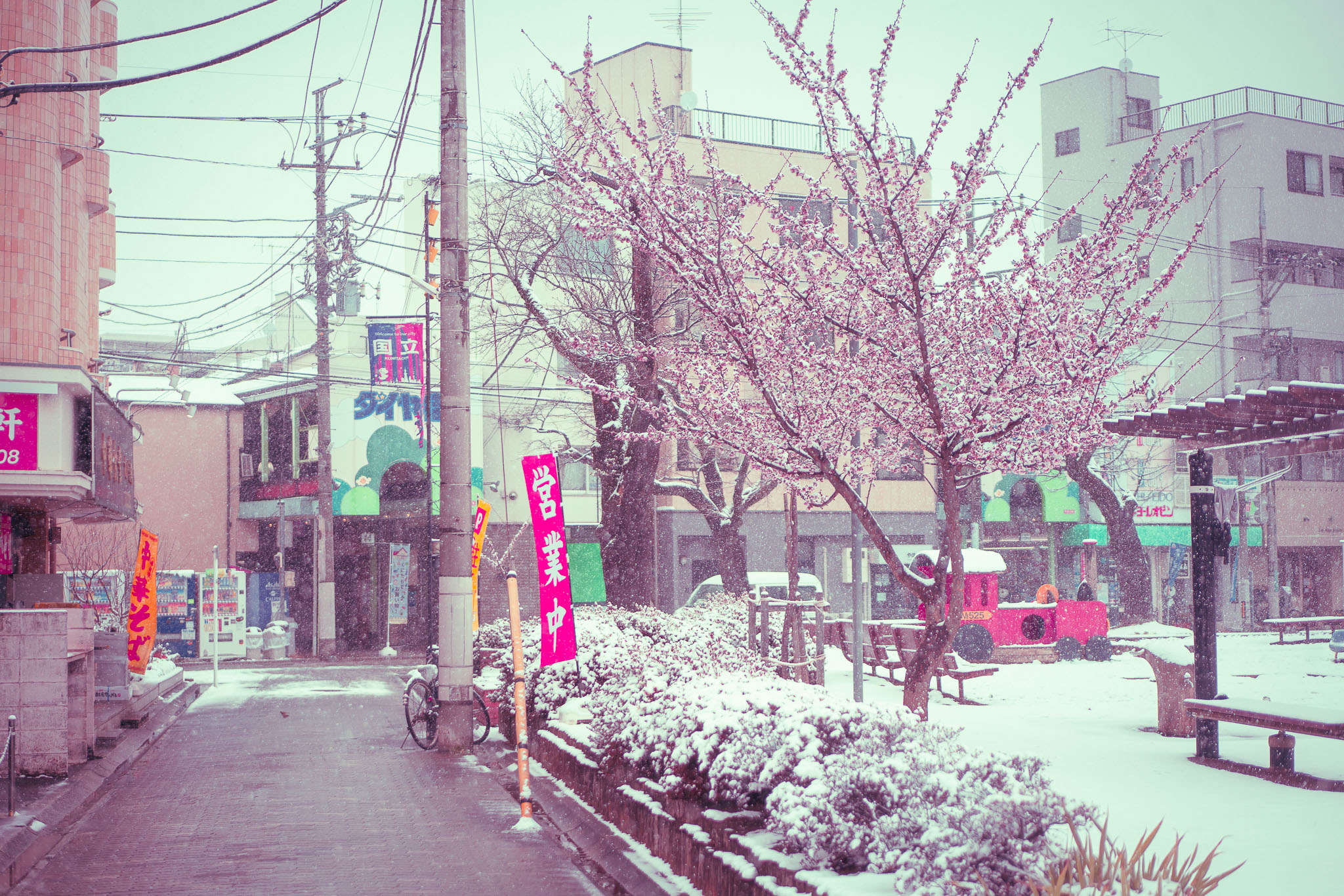
Tokyo's cherry blossoms and Tokyo snowfall don't usually share the calendar. Sakura peaks in late March to early April. Snow in Tokyo is a January or February event, occasionally early March. The overlap — blossoms open, snow falling — happens maybe once every few years, and when it does the city reacts with a particular combination of surprise and delight that feels very Japanese. Everything is briefly off-script. I happened to be out with a camera when it happened.
What It Actually Looks Like
The photos don't exaggerate it. A tree that was pink the day before is now half pink, half white, the blossoms holding snow that has no business being there in late March. The streets around it have that quiet Tokyo only gets during snowfall — fewer people, the sound different, the usual city pace suspended. Shop signs still lit. A bicycle left outside with snow accumulating on the seat. The particular soft grey-pink light that happens when snow falls in a city at street level.
It's the exact combination of things that shouldn't coexist that makes it work visually. Sakura is spring. Snow is winter. They operate in different registers of the year, and when they meet in the same frame it reads as something slightly wrong — a glitch in the seasonal calendar that turns out to be a gift. The color palette shifts significantly from standard sakura photography. Normal sakura has pink and sky blue and green. Snow sakura is pink, white, and grey. Muted, colder, quieter. The processing should reflect that.
When It Happens and How to Chase It
The years when this is possible are years when sakura blooms early — late March rather than the first week of April — and a late cold front follows. This is uncommon in Tokyo but not rare. The Japan Meteorological Corporation publishes sakura forecasts starting in January, and a combination of an early forecast and a cold front in the 10-day outlook is the pattern to watch for.
When snow is predicted during bloom, the practical window is narrow. The snow rarely sticks for more than a day, and the blossoms it accumulates on are usually knocked loose or melted off by the following morning. The window for photographing both things simultaneously is roughly the duration of the snowfall itself, plus a few hours after if temperatures stay low enough for the snow to remain on the branches. Set an alarm. Go immediately. Don't wait to see if it gets better — this is as good as it gets.
The Light and How to Expose for It
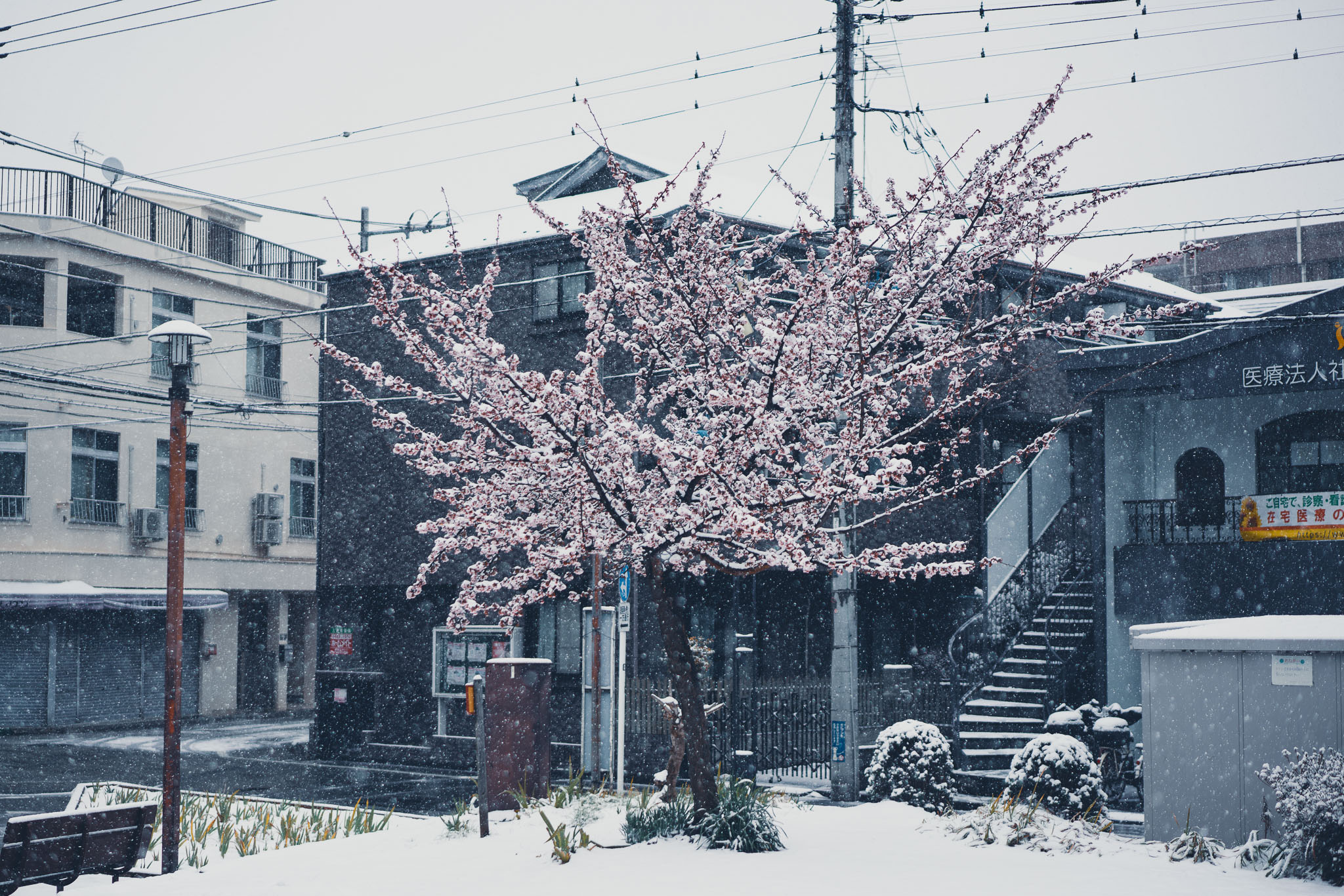
Snow falls under flat, diffuse, overcast light — the shadows disappear, the sky is a single grey tone, and everything is evenly lit from above. For most subjects this is mediocre light. For sakura in snow it's actually ideal, because the contrast between white petals and white snow requires detail in both, and hard directional light would make one or the other specular and featureless. The flat light during snowfall is the best light for this subject. Immediately after, when the sun comes back out, the snow on the blossoms starts melting and the specular quality you don't want arrives. The window is the storm itself.
The color cast during snowfall leans cool and slightly green depending on the sky — let it stay. The muted palette is part of what makes these images work. Trying to warm them up in post to look like a normal spring day removes the thing that makes them interesting. I tend to pull the saturation down slightly, keep the shadows lifted, and let the overall tone stay in that grey-blue-pink range. The pink of the blossoms reads more clearly against the cold palette than it would against a warmer one.
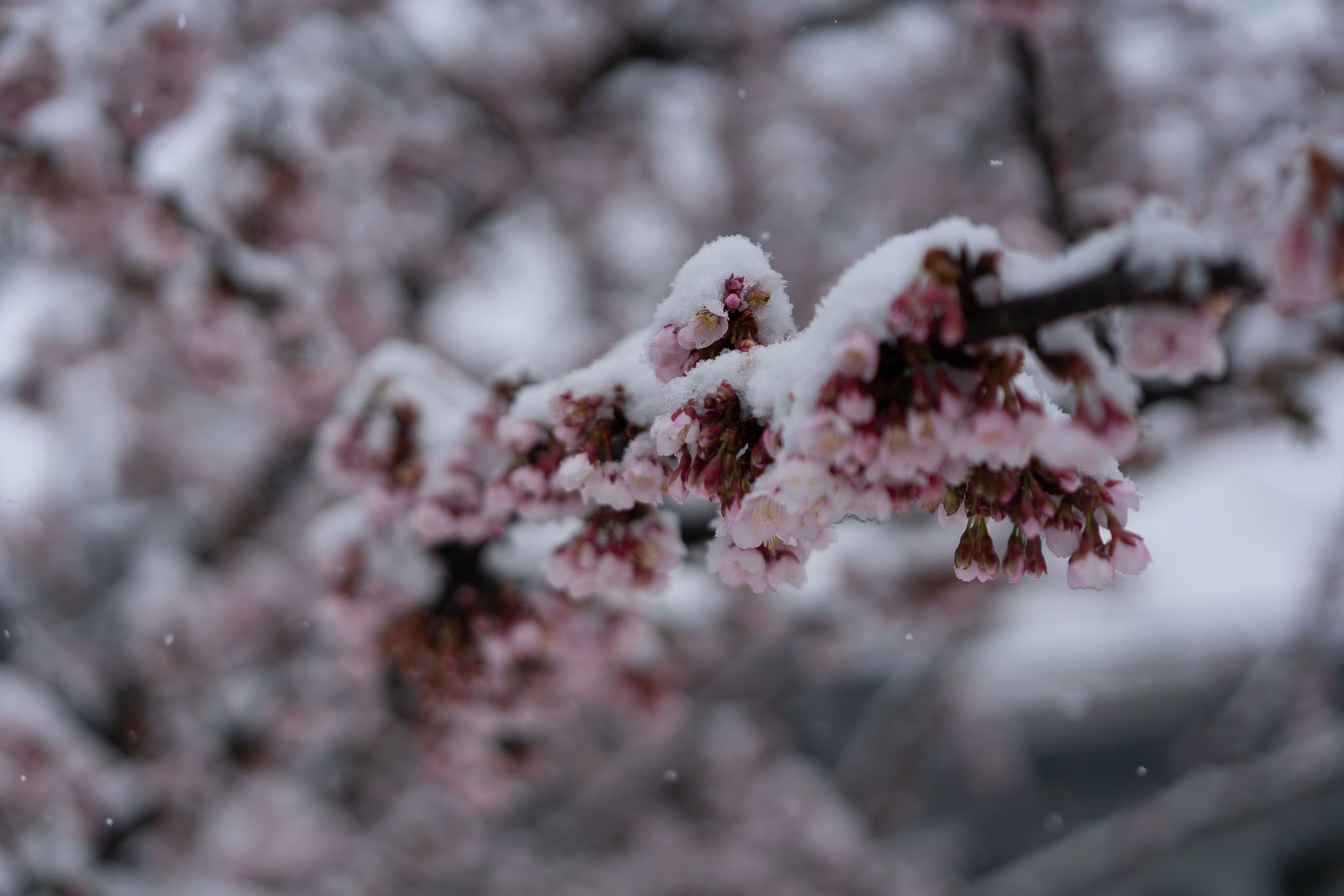
Exposure is simple — the scene is bright with all the white, so matrix metering will underexpose. Dial in +0.7 to +1 exposure compensation. Check that the snow on the branches has texture rather than blown-out white. RAW gives you margin here but the exposure at capture still matters.
Where to Go
Any quiet residential street works better than the famous parks. The famous parks will either be emptied by bad weather — most people don't do hanami in a snowstorm — or filled with photographers who had the same idea, which just recreates the crowd problem you were trying to escape. A neighborhood street with a single sakura tree in front of a shuttered shotengai. A temple yard. A small park near a suburban station where nobody has a reason to go in bad weather.
This is also not the time for the Meguro canal. The water is interesting in snow but the path is either empty in a way that reads as abandoned rather than atmospheric, or full of other people with the same idea. The image that works is a single tree — old, prominent, alone — with falling snow visible in the frame as motion blur. For that you need space around the tree and a background that doesn't fight it.
Western Tokyo suburbs work well for this specifically because they have quiet streets, older trees planted decades ago in residential blocks, and less foot traffic than anywhere central. Neighborhoods along the Chuo or Keio lines — Koenji, Asagaya, Kichijoji, Chofu — have this kind of material. You're not going there for a famous spot. You're going because there will be old cherry trees in front of ordinary buildings and nobody else will be out in the snow.
If You Miss It
You probably will. Most people who visit Tokyo during sakura season never see snow. The season is two weeks long, the late cold front is rare, and even when it happens the overlap might last a few hours before the temperature rises again. That's fine — the blossoms on their own are extraordinary and the regular version of sakura season doesn't need unusual weather to justify the trip.
But if you're in Tokyo in late March or early April and the forecast shows snow coming, sleep with your camera on the nightstand and your shoes by the door. The city will be quiet and strange and pink and white all at once, and it won't last.
Shooting in Tokyo this spring?
Book a Session in Tokyo →