
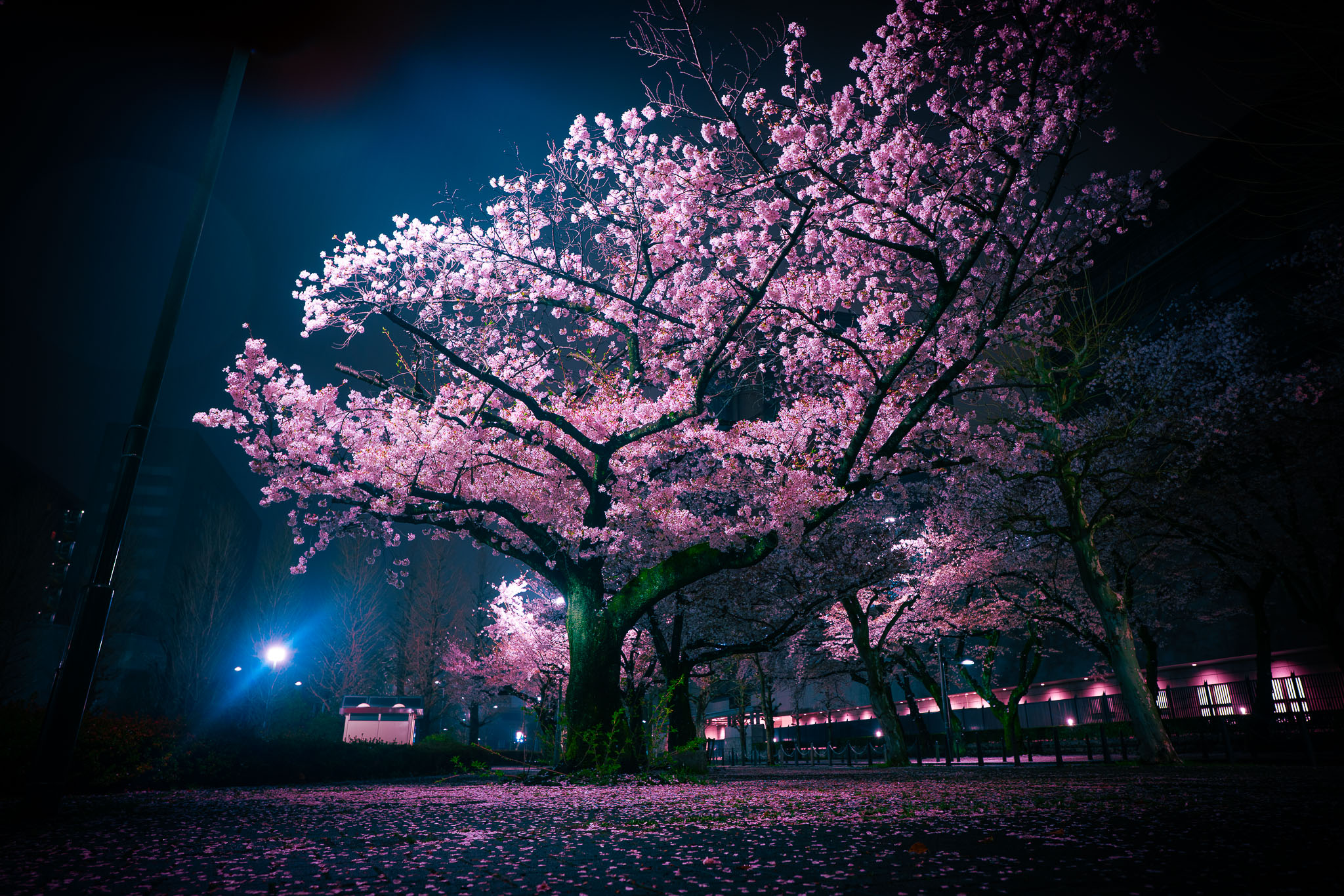
Yozakura means night sakura. It's a real word in Japanese and describes a real practice — sitting or walking under illuminated cherry blossoms after dark. Most of the famous hanami parks in Tokyo light their trees during sakura season, and the result is something that doesn't look like daytime cherry blossom photography at all. I prefer shooting sakura at night. Here's why, and how.
Why Night Works Better Than Day
The obvious answer is crowds. They thin dramatically after 9pm, even during peak season. The less obvious answer is that the light is simply more interesting. Daytime sakura photography spends most of its time fighting an indifferent grey sky — Tokyo in late March and early April is frequently overcast, and flat white sky behind pink blossoms produces flat white images. At night, that problem disappears. The sky goes dark, the artificial lighting becomes the whole story, and the blossoms respond to it in ways they never could in diffuse afternoon light.
In daylight, sakura is soft and pastel and diffuse. At night under artificial illumination, the blossoms become harder-edged — bright pink against deep black, high contrast, almost graphic. The petals catch the light differently depending on the source and direction, and when wind moves the branches you get motion through the frame that doesn't exist when everything is evenly lit. The image in the cover shot was made at 11pm in a small neighborhood park — not a famous spot, not on any tourist itinerary. Just a tree that happened to look extraordinary in the dark.
The Best Yozakura Locations in Tokyo
Chidorigafuchi is the most-known yozakura spot and it earns the reputation. The moat along the Imperial Palace edge gets lined with lit sakura trees, and the row boats on the water below create a moving foreground that changes every frame. The walking path fills up on peak-bloom evenings, but the light on the water and the overhead canopy from the bank is something worth doing at least once. If you want the boats, queue early — they sell out fast on busy nights.
Ueno Park has one of the oldest and densest sakura groves in the city. At night during peak season it turns into a full festival — food stalls, groups doing hanami under blue tarps, lanterns strung between the trees, noise. Photographically it works if you lean into the chaos rather than trying to isolate clean subjects within it. The combination of the lit canopy above and the festival below produces images that don't look like anything else in Tokyo. It's not the quiet version, but it's honest.
Shinjuku Gyoen normally closes at dusk but runs evening admission events during sakura season in some years. If they're happening when you're there, go. The garden has several different sakura varieties that bloom at slightly different times, and the combination of the formal garden layout and the lit trees is calmer than any of the street parks. The variety also means you sometimes catch trees at peak when everything around the city has already peaked and dropped.
The Meguro River at night is a different experience from the daytime canal. The city lights reflect off the water, the lanterns strung along the path come on, and the crowd is manageable after dark in a way it isn't on a Saturday afternoon. The fallen petals on the surface at hanafubuki stage look particularly good under artificial light — the petals pick up the yellow of the lamps and the whole canal surface glows.
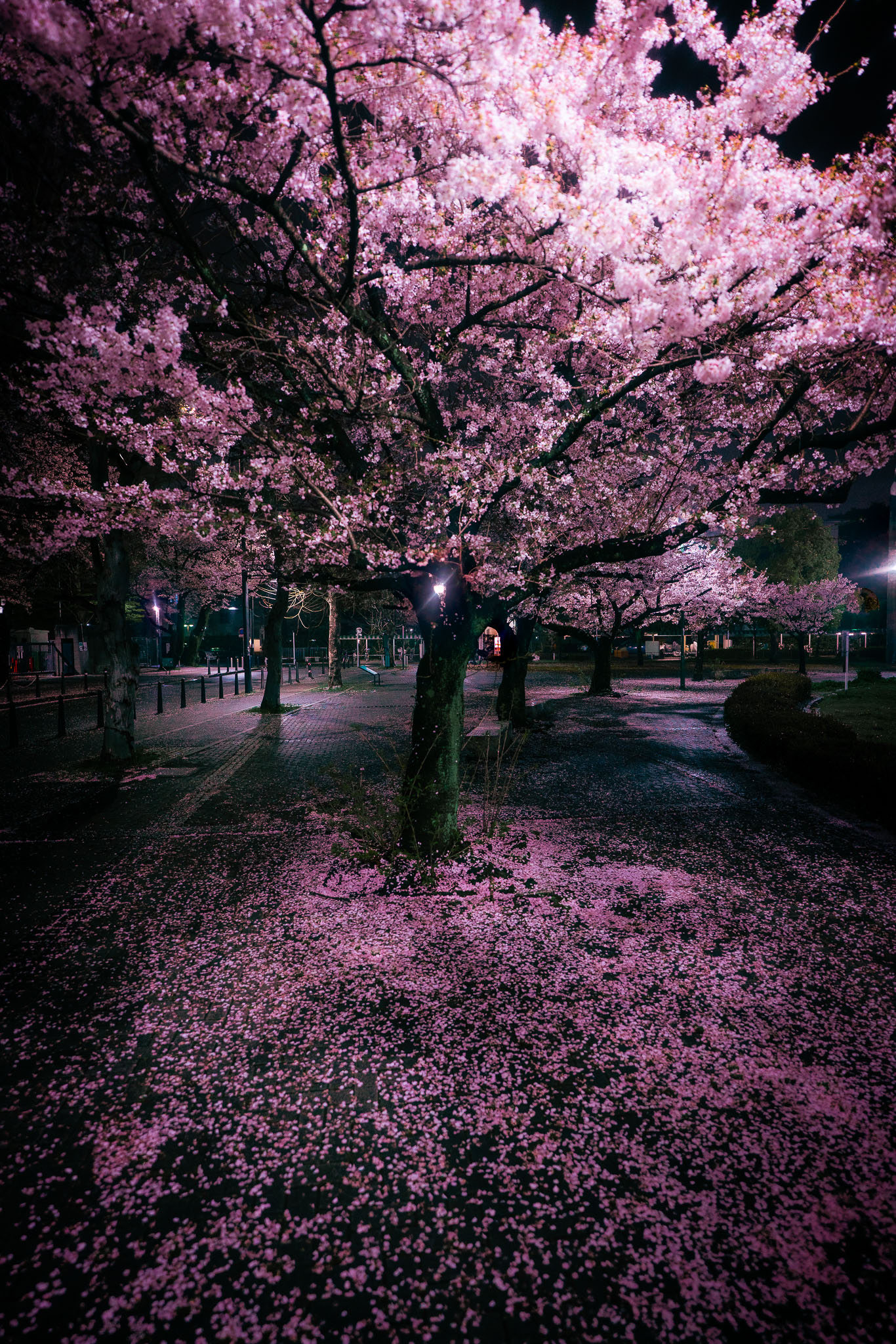
For me, the best yozakura photography consistently happens in small neighborhood parks rather than any of the famous spots. A single old tree in a local park, lit by a street lamp at an oblique angle, petals accumulated on the concrete below, nobody else there. This is the frame that holds up longest after the season is over, because it has a subject in it — not just atmosphere.
Settings for Night Sakura Photography
The blossoms are bright white-pink under artificial light and the background is close to pure black. This is actually a more forgiving exposure situation than general night photography because the subject is well-lit and you're not trying to balance competing sources. The challenge is preventing the bright blossoms from blowing out.
I shoot at f/1.4 to f/2 on the 50mm GM, ISO 1600 to 3200 depending on how much light is hitting the tree, shutter around 1/100 to freeze wind movement in the branches. If it's very still you can go slower, but moving blossoms at 1/30 go soft quickly and the softness reads as a mistake rather than motion blur. Check the shutter speed before you start and adjust if there's any wind.
The thing to avoid is letting the camera expose for the dark background — matrix metering will try to bring up the shadows and overexpose the lit blossoms badly. Dial in -0.7 to -1 exposure compensation and check the highlights on your histogram. Blown white in cherry blossoms is very obvious and difficult to recover. Shooting RAW gives you more margin but the highlight discipline still matters at capture.
Shooting wide open on a fast prime gives you out-of-focus bokeh clusters in the background when there are other lit trees behind your subject. At f/1.4 these become soft circles of warm light rather than identifiable objects, which adds depth without adding visual competition. The 50mm focal length compresses the scene enough that even a modest cluster of background trees creates a wall of bokeh behind the subject.
When to Go
The yozakura window is roughly 9pm to midnight during peak bloom week. Before 9 the crowds are still heavy and the atmosphere is more festival than photography. After midnight most parks thin out entirely and the mood shifts — quieter, more atmospheric, less colorful. Both have their uses depending on what you're after.
Weeknights are significantly better than weekends. The famous spots on a Friday or Saturday night during peak bloom are genuinely difficult to work in. Come back Tuesday at 10pm and it's a different city. The trees are the same trees.
Want to shoot Tokyo's sakura season together?
Book a Session in Tokyo →