
Koenji sits one stop past Nakano on the JR Chuo line, one stop before Kichijoji, and it doesn't behave like either neighbour. Nakano has its arcades and its otaku culture. Kichijoji has climbed to the top of every livability survey Tokyo runs. Koenji has spent forty years building a reputation as the place where secondhand clothing, small live-music venues, and a general disinterest in looking presentable all reinforce each other, and none of that has changed because the rest of the city got nicer.
It's the neighbourhood I'd send someone who's already done Shinjuku and Shibuya and wants to see what "old Tokyo alternative culture" actually looks like once you strip out the tourism layer.
Pal and the Rainbow Entrance
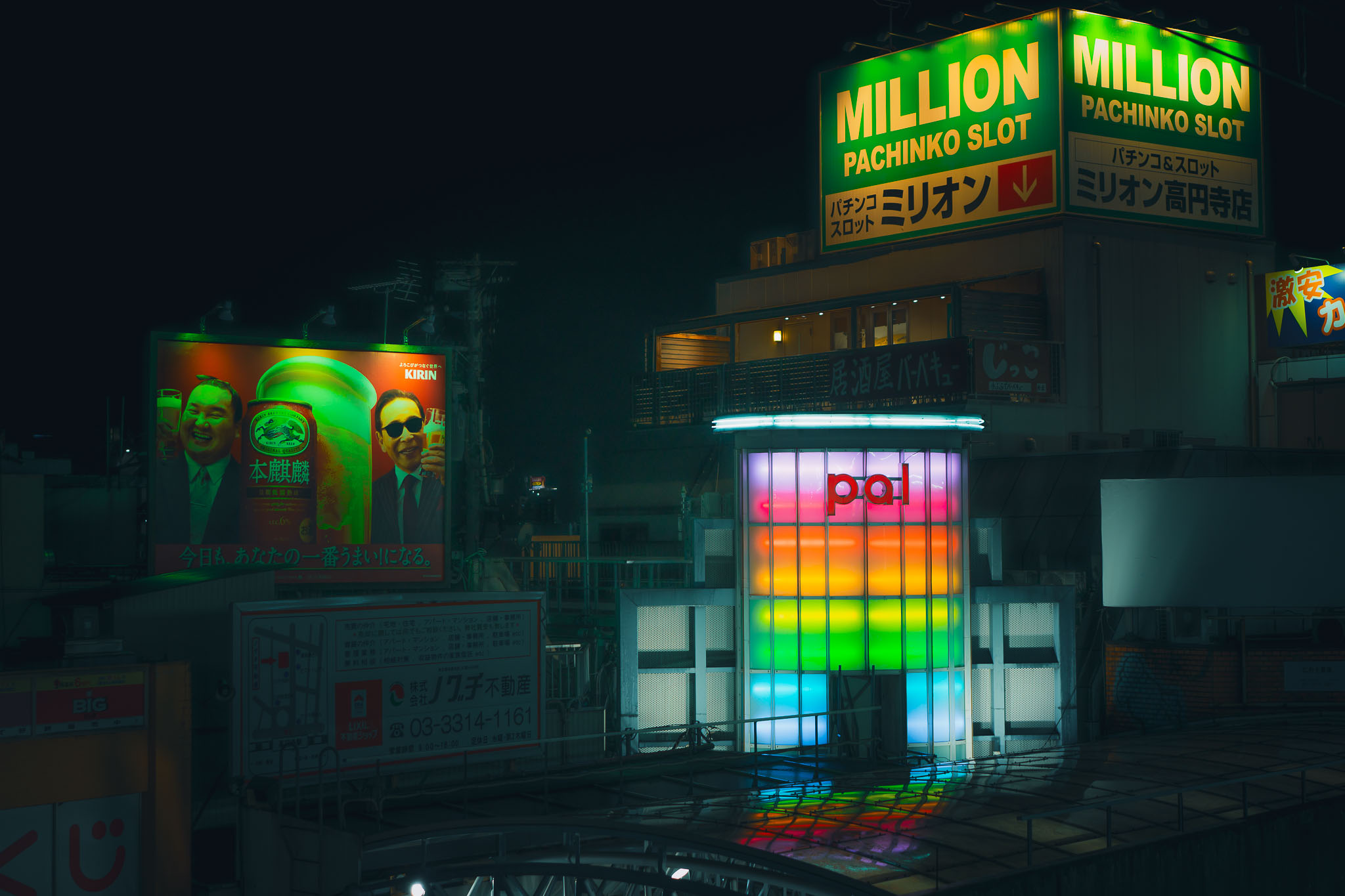
Pal Shopping Street runs south from the station and is the commercial spine of Koenji — record shops, thrift stores, ramen counters, a giant green PACHINKO SLOT sign that dominates the skyline the second you step off the platform. At the entrance to one of the side buildings there's a glass elevator shaft lit in a full rainbow gradient, top to bottom, that turns the wet pavement underneath it into a smear of color. It's not trying to be a photo spot. It's just how the building is lit, every night, whether anyone's pointing a camera at it or not.
That's the thing about Koenji that separates it from neighbourhoods built around a single famous view: nothing here is staged for the shot. The rainbow glass, the pachinko sign, the Kirin beer billboard with two grinning salarymen from a decade-old ad campaign — it's all just infrastructure that happens to be gorgeous at night. You show up, you frame it, you don't wait for anything to happen because it's already happening.
The Alleys Behind Pal
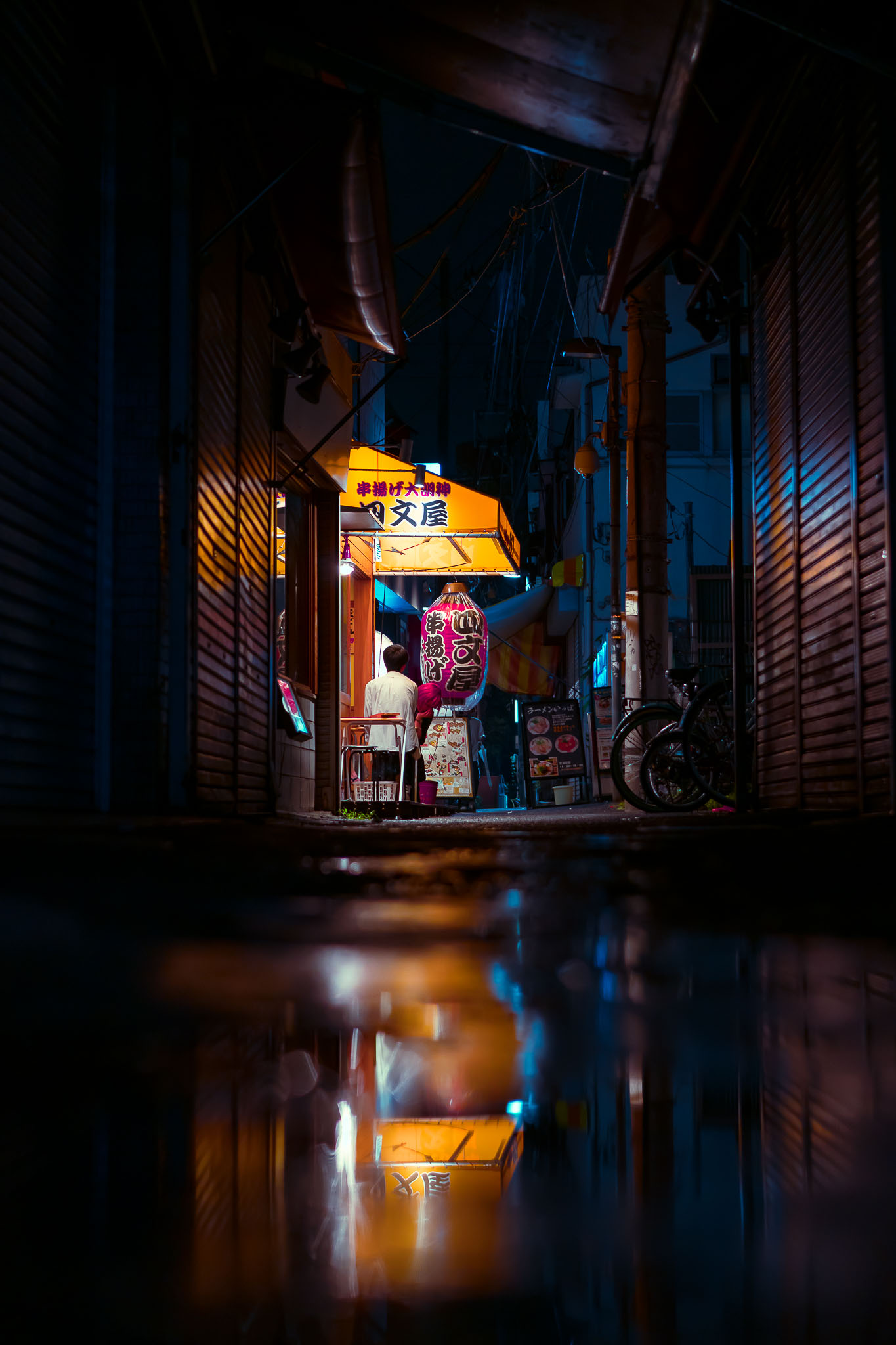
Turn off the main street and Koenji gets narrower fast. The backstreets are lined with kushiage counters and standing bars, most seating six people max, awnings low enough to duck under. I found a skewer joint — a yellow sign, a single pink paper lantern reading kushiage — down an alley barely a meter wide, wet from earlier rain, with a bicycle parked outside and nobody around except the guy working the counter. Get low, shoot straight down the alley, and the reflection in the puddle doubles the lantern and the sign into something that reads more like a diorama than a photograph.
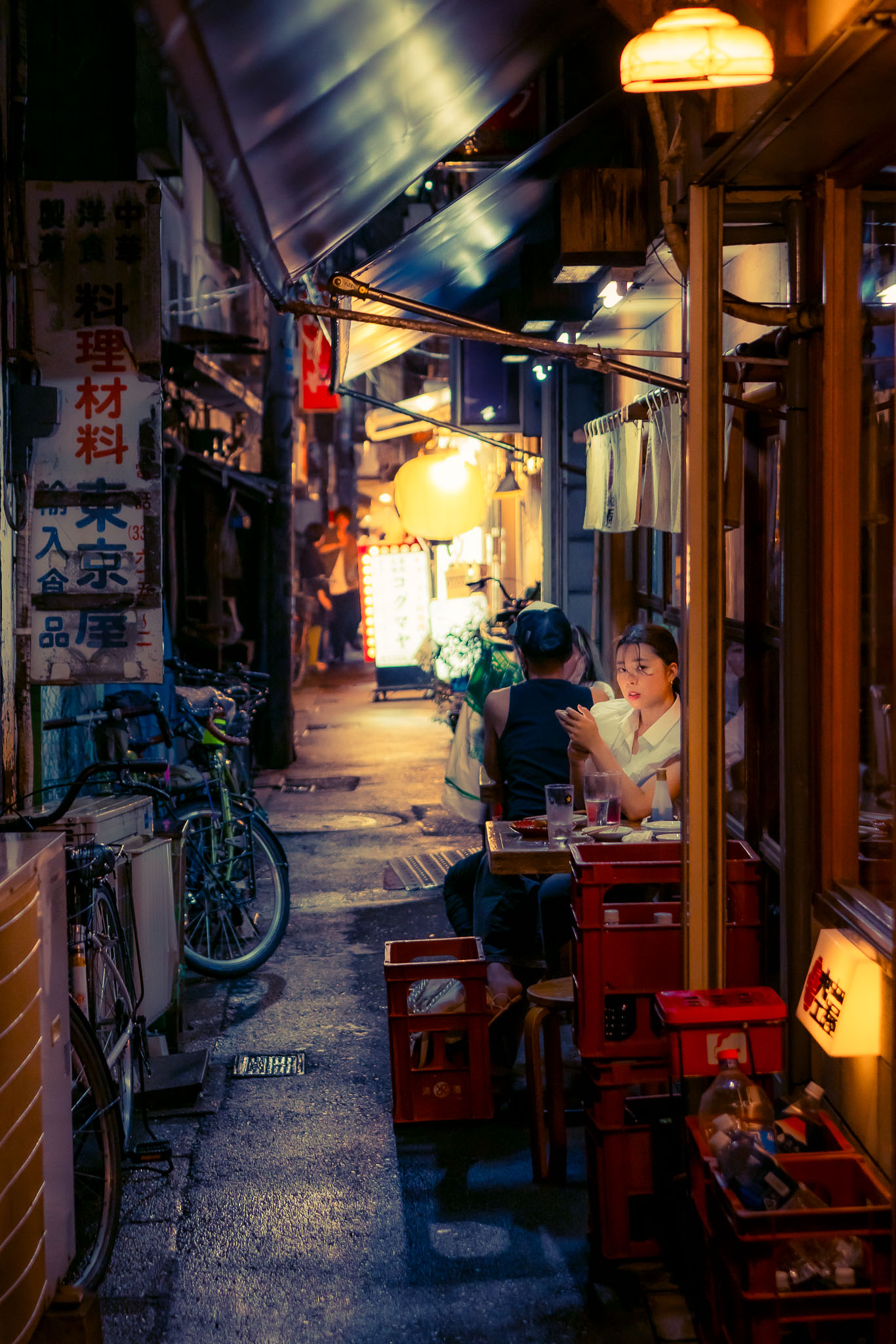
Further in, the alleys open into small pockets with a table or two set up outside a bar — nothing formal, just crates for seats and a lantern hanging low enough to light the whole scene by itself. I caught a couple mid-conversation at one of these low tables, lit almost entirely by a single paper lantern, bicycles leaning against the wall behind them, a faded "Tokyo-ya" sign further down the alley. It's the kind of frame that only exists because Koenji still has bars that put a table on the street and call it seating.
Vintage, Live Houses, and the Awa Odori
Koenji's reputation as Tokyo's secondhand clothing capital isn't marketing — the density of vintage shops around the station is real, and most of them have been run by the same people since long before "vintage" was a category anyone advertised. Attached to that is a live-house scene that's kept Koenji's punk and indie identity alive since the 70s, small venues where the band and the audience are separated by about a meter and nobody minds.
Once a year, in late August, the neighbourhood hosts the Koenji Awa Odori — the second-largest Awa Odori dance festival in Japan after the original in Tokushima, over a million spectators across two days, dancers in traditional costume moving through streets that are usually this quiet and unpolished. It's worth timing a trip around if you can. The rest of the year, the crowd stays younger, scrappier, and less interested in being photographed than most of Tokyo's nightlife districts — which, if you're the one holding the camera, is exactly the point.
Why Koenji
It doesn't have Kichijoji's polish or Nakano's density of arcades. What it has is texture that hasn't been sanded down — vintage shops that still smell like the 90s, alleys that haven't been redesigned for foot traffic, a rainbow-lit entrance that exists for no reason other than someone thought it would look good. The buildings are old. The crowd, somehow, keeps getting younger. That contrast is the whole neighbourhood.
One stop past Nakano. Worth getting off the train for.
Want to shoot Tokyo's less obvious neighbourhoods properly?
Book a Night Session in Tokyo →