
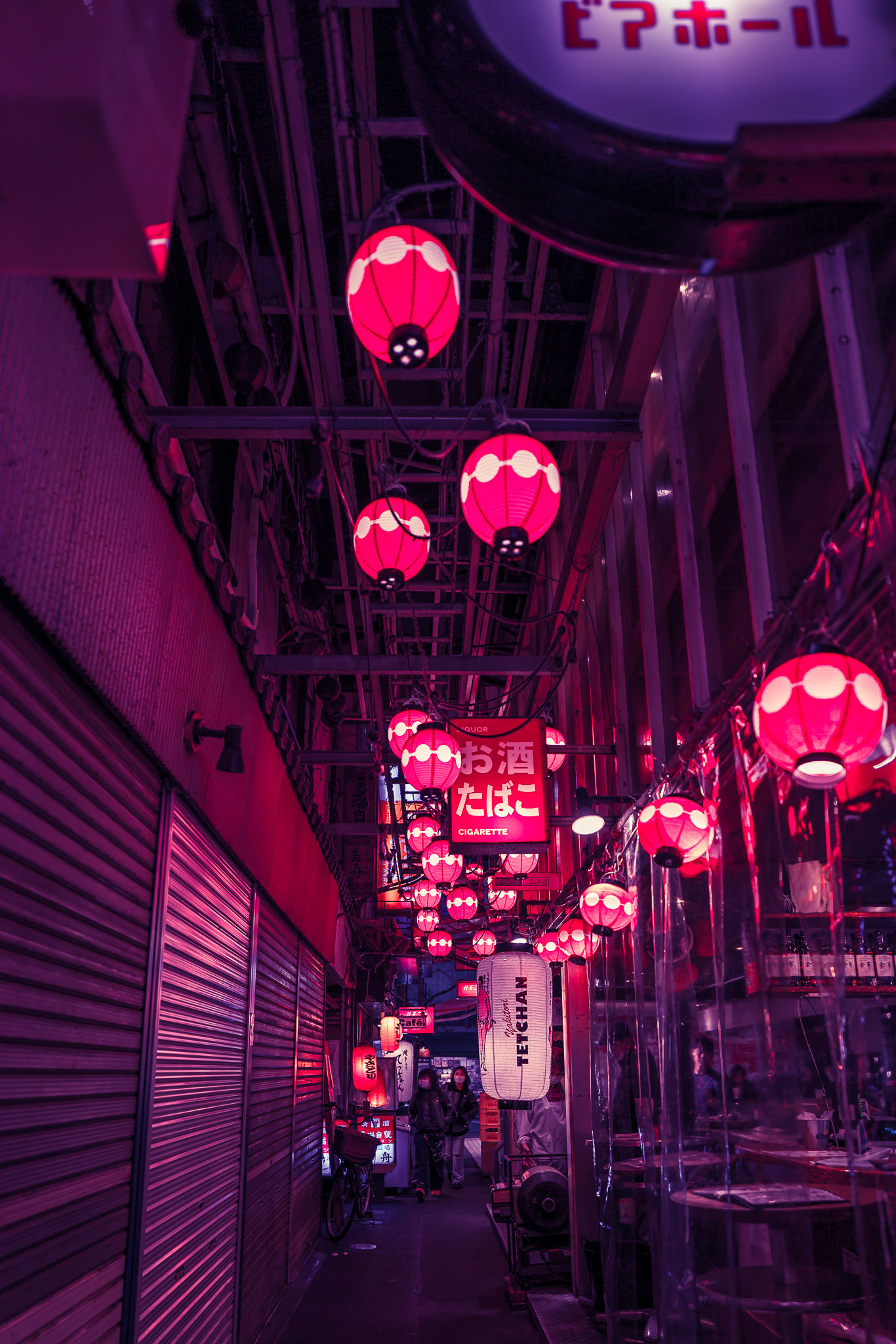
Kichijoji sits a few stops further west than most tourists bother going — past Nakano, past Koenji, off toward the edge of what people mean when they say "Tokyo." Every livability ranking in Japan puts it near the top. Ask a Tokyoite where they'd move if money weren't a factor and a lot of them say Kichijoji without thinking about it. Ask a first-time visitor to name it and most of them can't.
That gap is the whole appeal. It's a neighbourhood built for people who live here, not for people passing through, and that shows up in the way it photographs — nothing staged, nothing performing for a camera, everything just doing what it does at ten at night on a Tuesday.
Harmonica Yokocho
The alleys behind the station's north exit are called Harmonica Yokocho — harmonica alley, named for how the tightly packed stalls look from above, reed by reed. It's the same idea as Golden Gai in Shinjuku, minus the crowds and minus most of the English menus. Standing bars, counter seats for four, a Budweiser sign glowing pink in a passage barely wide enough for two people to pass without turning sideways.
What makes it work for a camera is the compression. The alleys are narrow enough that a single neon sign lights the whole frame, and the pipes and wiring and satellite dishes overhead become part of the composition whether you plan for it or not. Nobody's posing. A guy walks toward a lit doorway with his hands in his pockets and that's the photograph — you don't need him to do anything else.
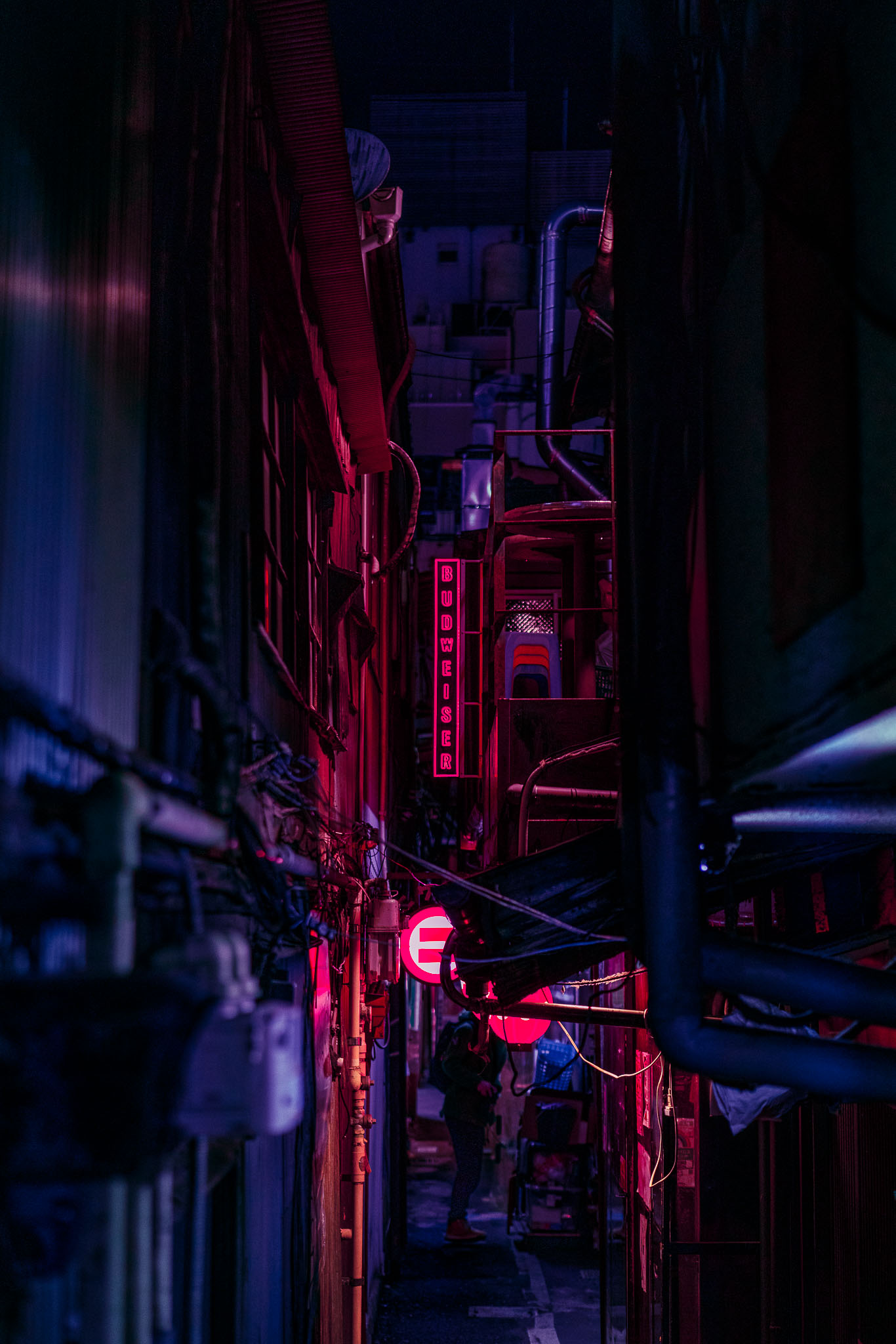
Go on a weeknight, not a weekend. The bars are small enough that a Friday crowd spills into the walkways and kills the shot — too many people, too much motion, not enough of the alley itself visible in the frame. A Tuesday at nine gives you the lanterns, the signs, and just enough foot traffic to put a human being in the composition without losing the space around them.
Diamond Street in the Rain
South of the station, Diamond Street — Daiyagai, if you're reading the signage — is Kichijoji's main covered shopping arcade, all karaoke boxes and pachinko parlours and small restaurants stacked three floors high. During the day it's just a shopping street. At night, in rain, it's something else.
Wet pavement turns every sign into two signs — the real one and its reflection, doubled and slightly softened in the puddle. I got low with the camera near the arcade entrance one rainy night and caught a delivery truck parked under the neon, its mirror image sitting in a puddle at my feet, the whole frame split evenly between what was actually there and what the ground was doing with the light. That's the trick with rain in Tokyo — it isn't a problem to shoot around, it's a second light source you didn't have to install.
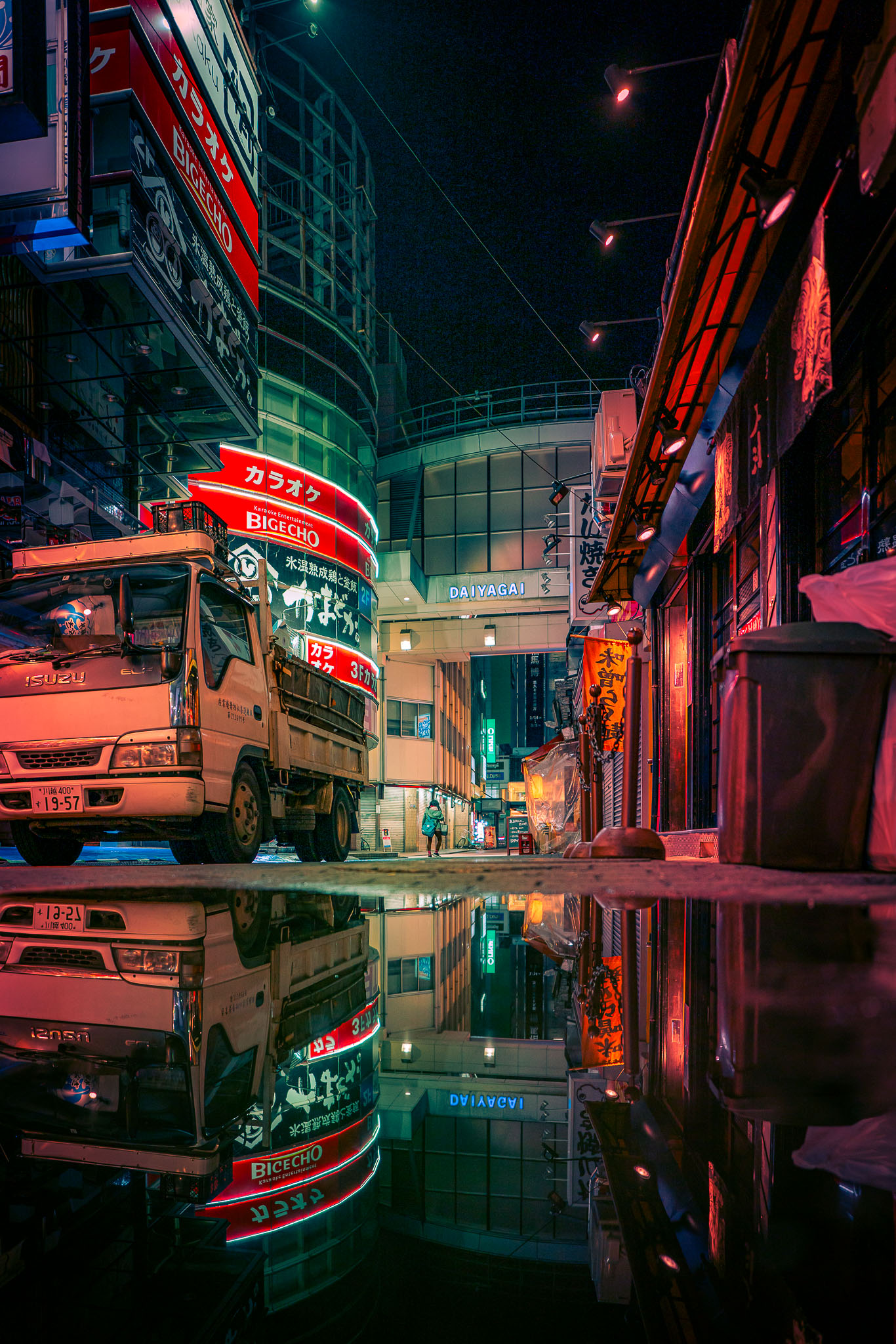
The green and red karaoke signage does something to the reflection that white light doesn't — it holds its saturation even diluted in a puddle, which is why this corner works better than most of the arcade. Get there right as the rain starts easing, while the ground's still fully wet but people are coming back out. That ten-minute window is worth the wait.
Twenty-Five Years, Same Sign
A few blocks in, there's a ramen shop on a corner with a hand-painted banner that reads, roughly, "twenty-five years in Kichijoji, still making ramen." No rebrand, no seasonal menu photographed for Instagram, just bicycles leaning against the wall and a red lantern over the door doing the same job it's done for a quarter century. It's a small detail, but it says something about the neighbourhood — things here get to stay exactly what they are for a long time, because nobody's trying to flip them into something more marketable.
That's true of a lot of Kichijoji. It has Inokashira Park a few minutes south, one of the better places in Tokyo to shoot in autumn, and it has a jazz-and-vintage-clothing reputation that's kept mostly intact since the 90s. None of it feels preserved for tourists. It's preserved because the people who live there like it the way it is.
Why Kichijoji
It doesn't have a single postcard shot the way Shibuya has its crossing or Asakusa has its temple gate. What it has instead is density of atmosphere spread across a smaller area than you'd expect — Harmonica Yokocho, Diamond Street, the park, the backstreets between them, all walkable inside twenty minutes. You can shoot a full night here without taking a train between locations, which isn't true of most neighbourhoods this far out from central Tokyo.
It also rewards repeat visits in a way flashier neighbourhoods don't. Shinjuku gives you most of what it has on the first trip. Kichijoji gives you a little more each time — a bar you missed in the alley, a reflection you didn't notice was possible, a shop sign that's been there longer than you have. Most livable neighbourhood in Tokyo, according to everyone who actually lives here. Worth finding out why yourself.
Want to shoot Tokyo's less obvious neighbourhoods properly?
Book a Night Session in Tokyo →