
I don't usually write about cars. I shoot cities, I shoot people in cities, I shoot the light that accumulates in the places where people eat and drink and move around at night. Cars are usually background — tail lights pulling away, a shape in the frame that adds context or scale but isn't the subject.
The Toyota AE86 is an exception. It has a specific cultural weight that's worth understanding before you look at these photographs.
What the AE86 Is
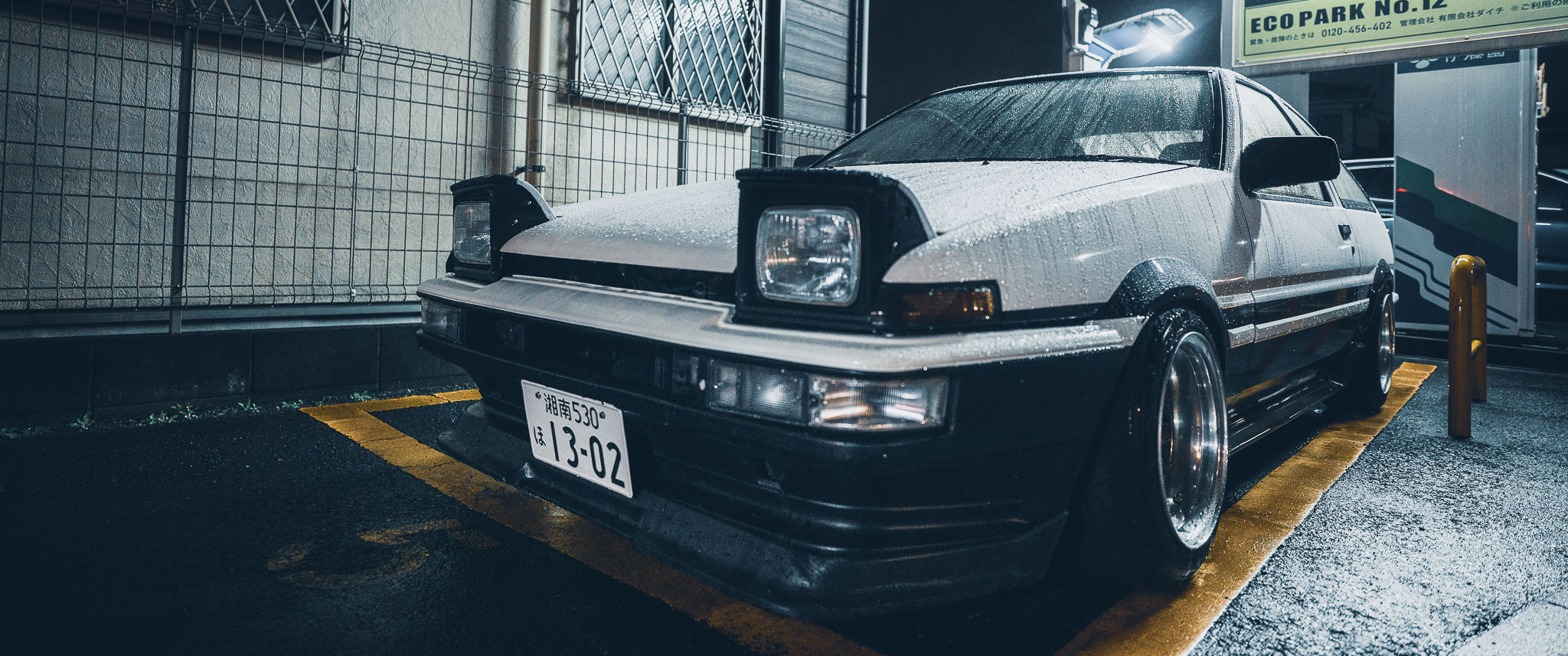
The AE86 — Hachi-roku, "eight-six" in Japanese — is a 1983 to 1987 Toyota Corolla in two configurations: the Levin, with fixed headlights, and the Trueno, with pop-up headlights. The one in these photographs is a Trueno. You can tell by the pop-up lights, which are the detail everyone thinks of when they picture the car.
On paper, it's not an impressive machine. 128 horsepower from a 1.6-litre naturally aspirated engine, rear-wheel drive, light enough to feel the road through the chassis. What it has instead of power is balance — a reputation for teaching the people who drive it how to actually drive, because the car will respond to everything you do and give you immediate feedback on whether you got it right.
In Japan, the AE86 is the Initial D car. The manga ran from 1995 to 2013, the anime followed, and the premise — a teenage tofu delivery driver descending mountain passes in his father's AE86 at speeds that made no physical sense — created a cultural object that fused the car with a specific mythology about skill, precision, and the mountain road as a place to find out what you're made of. A generation grew up with that story and many of them eventually bought AE86s, or found one in a field and spent years putting it back together, or at minimum stopped whenever they saw one parked somewhere.
I am, apparently, one of those people.
Finding It
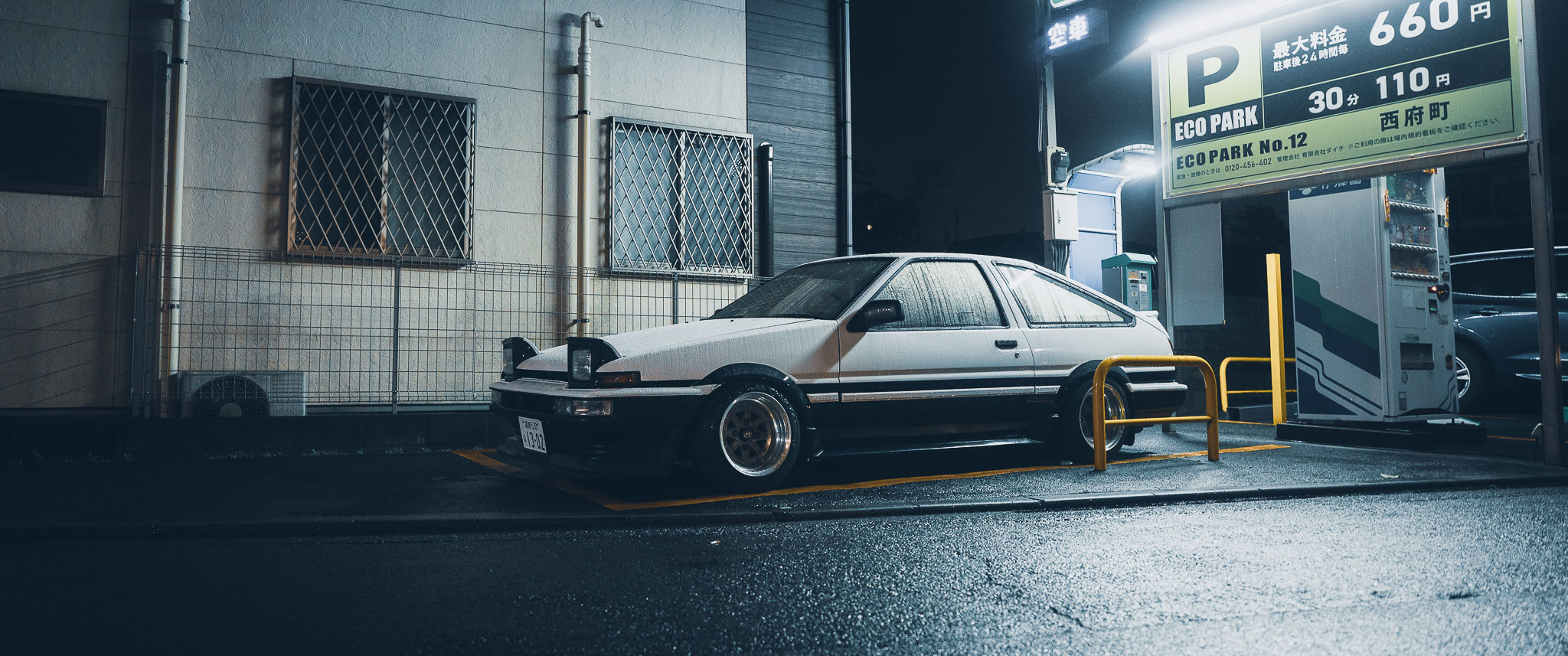
I found this one in a coin parking lot in Nishifu, a quiet area west of Fuchu in Tokyo. Shonan plate — 湘南530, which means it was registered in Kanagawa Prefecture, someone had driven it up from the coast. It was sitting in one of the marked spaces at ECO PARK No.12, doing nothing. The rain was coming down properly, the sustained kind that soaks into everything and makes the ambient light go strange.
I walked past. I kept walking. I came back.
The pop-up headlights were deployed, which on an AE86 is the equivalent of a face fully awake. The white paint had gone grey-wet and the water was running off every surface. The parking lot fluorescents overhead were doing their flat industrial thing, which you can either fight or use. I used it.
What Rain Does to Bodywork
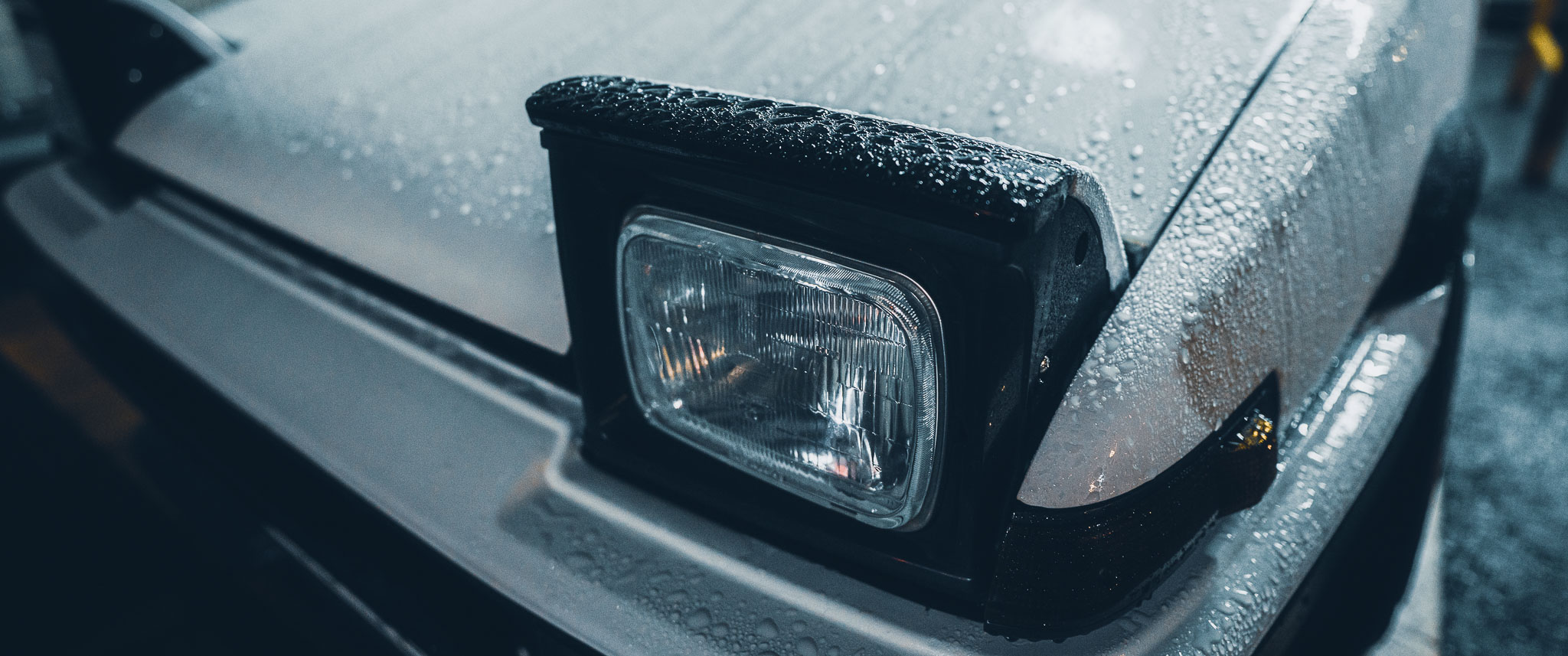
Rain on a car creates surface texture that flat dry paint doesn't have. Every water droplet catches and holds a point of light, and on a white car in low ambient light, the effect is something close to luminescence — the surface appears to generate light rather than reflect it. The taillight cluster on the AE86, red and amber behind water-covered polycarbonate, photographs completely differently wet than dry. The depth increases. The color saturates.
The pop-up headlights are a specific gift for close work. The housing — black rectangular box, the headlight itself sitting inside — creates a frame within the frame when you get tight on it. Rain droplets on the housing surface, the light catching the edges of the lens, the white bodywork curving away into the dark. That's a photograph that doesn't require a beautiful location or perfect light. It just requires getting close and knowing what you're looking at.
On Shooting Cars
The principles are the same as anything else. Find the light, work the angle, wait for the elements of the frame to align. Cars reward close work more than most subjects — get close enough that the body geometry fills the frame and the background turns abstract. Pull back and you get the car plus a lot of context that usually isn't doing much. Move in and let the shapes and surfaces become the subject.
Modern cars are harder to photograph than they look. The surfaces are too smooth, the shapes resolved by computer optimization into something aerodynamically efficient but visually soft. The AE86 has actual edges — the sharp cut of the pop-up headlight housing, the squared-off rear, the stance on proper aftermarket wheels that drops it close to the ground. These are things to work with. A frame car with interesting geometry in the rain produces photographs. A smooth modern SUV in the rain produces documentation.
I don't usually write about cars. I might do it again. The conditions have to be right — something with genuine character, bad weather, and the kind of accidental encounter where you walk past and then turn around. You can't plan for that. You just have to be out when it's raining.
More interested in Tokyo's streets than its parking lots?
Book a Night Session in Tokyo →