
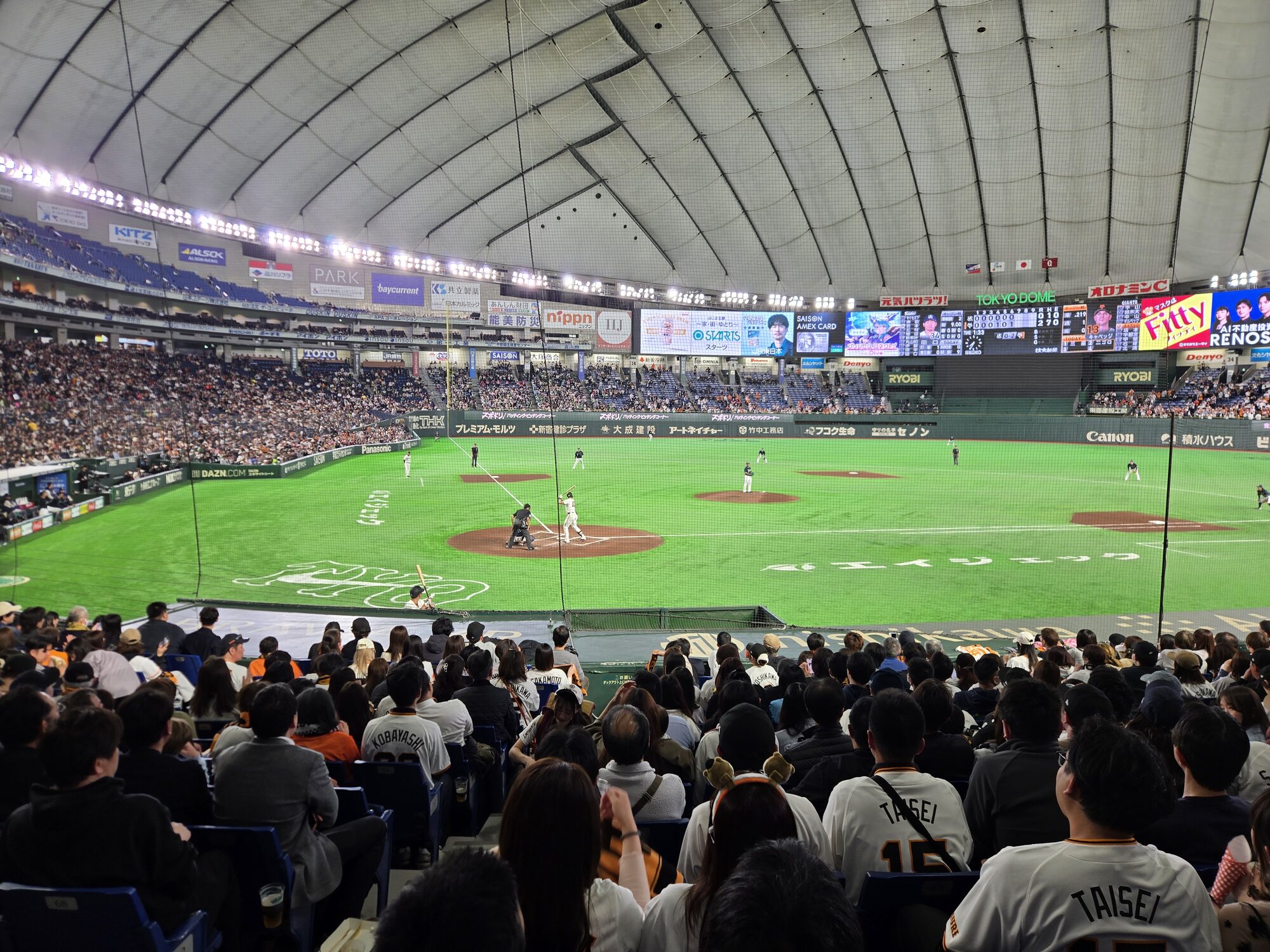
The Tokyo Dome is not a subtle building. It's a white inflated bubble in the middle of Bunkyo — the first domed stadium in Japan, opened in 1988, and still the only one in central Tokyo. It holds 55,000 people for baseball. The roof is kept pressurized to maintain its shape, which means the doors operate as airlocks and the whole interior has a slightly different atmospheric feel to anywhere else in the city. I went in March for a Yomiuri Giants home game and stayed until the ninth.
The Giants
The Yomiuri Giants are Japan's most storied baseball franchise — the Yankees equivalent, in terms of history, national reach, and the degree to which fans of other teams have a complicated relationship with them. They've won more Japan Series titles than anyone else. The Tokyo Dome is their home ground. A home game here fills the stands in a way that smaller parks don't, and the Giants fanbase brings coordinated chanting, towel-waving, and a level of organisation that makes western sports crowds look improvised by comparison.
The visiting team fans are penned into their own section — usually the outfield — and run their own parallel chant track the whole game. Both sets of supporters keep going continuously, not just on big plays. The sound is constant and layered and oddly musical. It's different to the stop-start rhythm of stadium noise you get elsewhere.
What the Dome Does to Light
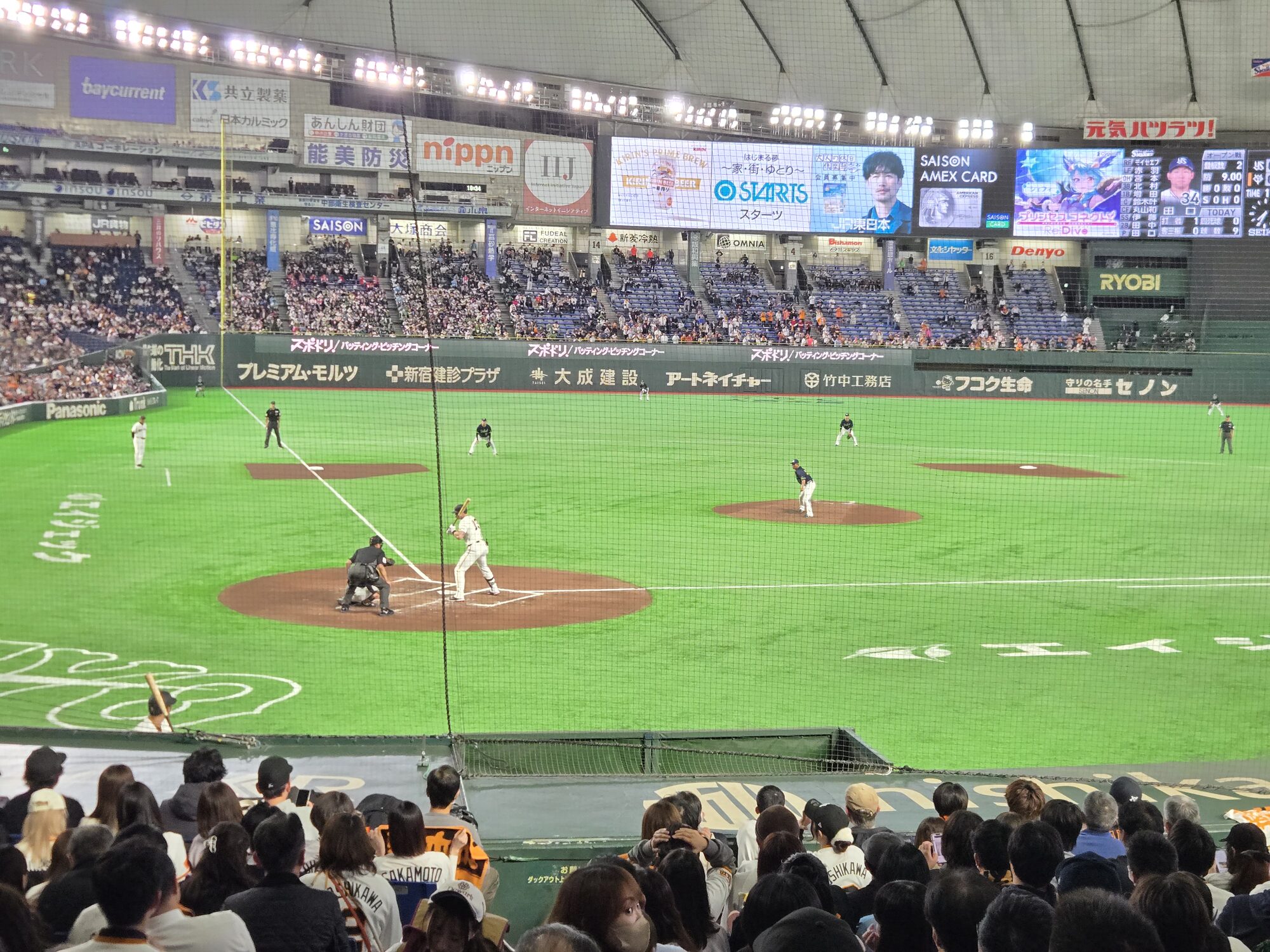
The artificial lighting inside the dome is very even and very bright — designed for broadcast, not for photography. Everything is lit from above with no meaningful directionality. The turf reads an almost unnatural green, the kind of colour that doesn't exist in outdoor daylight. On a Sony A7R IV with a 50mm, I was shooting at ISO 3200 to get any shutter speed fast enough to freeze the pitcher's delivery. The results were usable. They didn't have the drama of nighttime street photography.
What works better is wide — the crowd, the geometry of the stadium, the way 55,000 people fill a dome. The infield from above has a graphic quality. You're not shooting sports photography; you're shooting the spectacle of a Japanese institution doing what it does. That framing gets you further than trying to nail a shot of the ball leaving the bat.
The Experience
You can buy beer from vendors who circulate the stands carrying tanks on their backs — kegs they wear like backpacks with a tap at the front. The concession options inside are broader than most western stadiums, ranging from proper bento boxes to hot dogs to things that don't have an obvious equivalent. Nobody is being aggressive about any of it. The crowd is dense but orderly. The ushers are attentive in the way that Japanese service staff are always attentive — present without being intrusive.
Baseball moves at its own pace and the Dome amplifies that. There is a lot of time between pitches, between innings, between anything happening. The cheering fills that time. In the seventh inning stretch, the Giants fans release balloons simultaneously — a coordinated inflation-and-release that turns the whole home section into a brief cloud. It lasts about forty seconds and then it's gone and the game resumes.
Getting There
The Tokyo Dome is walkable from Suidobashi station on the JR Chuo-Sobu local line and from Korakuen on the Marunouchi and Namboku lines. It's also directly connected to Suidobashi on the Toei Mita line. On game nights the area fills quickly — the Dome is part of a larger complex with a hotel, an amusement park, and LaQua, so there's always foot traffic regardless. Come early enough to find your seat before the first pitch.
Tickets are available through the Giants' official site or through Lawson and 7-Eleven ticket machines. Good seats go early for weekend games. I went on a Tuesday in March and had no trouble finding a decent mid-tier view for around ¥3,500. The cheap outfield seats will put you behind the visiting team section, which is its own experience.
Worth It
You don't need to care about baseball to have a good night at the Tokyo Dome. The game is ambient as much as it is sporting — something happening at a known pace while the crowd does what it does around it. March is early in the NPB season, which means the stadium isn't as hot as it gets later in the summer when the dome traps the humidity and the temperature climbs regardless. If you're going to go, March or April is the right call.
Bring your camera. Manage expectations about what indoor dome light produces. Shoot wide. Stay for the balloon release.
Looking to photograph Tokyo — the parts that don't show up in guides?
Book a Session in Tokyo →