
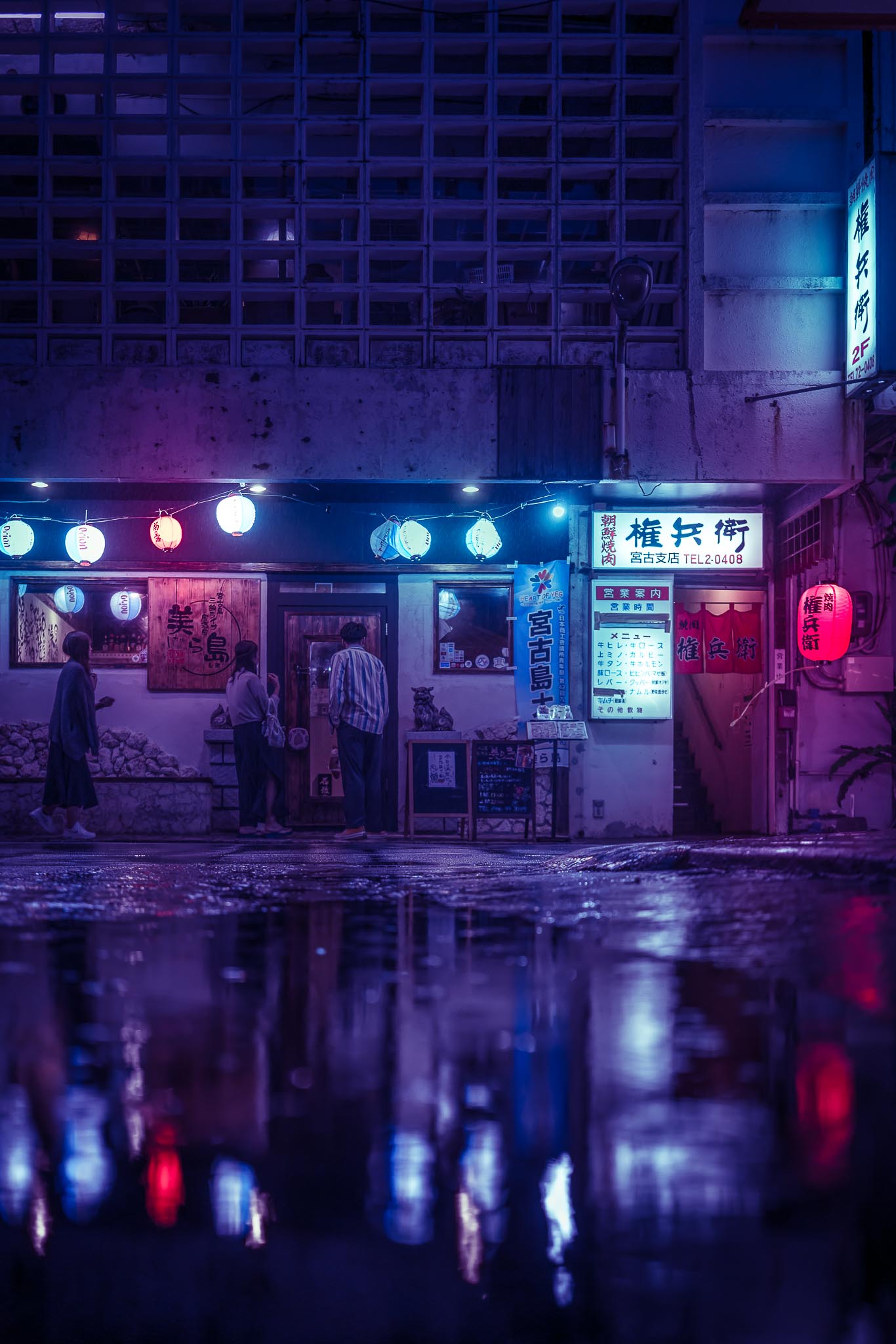
The first thing I noticed was the cars. Okinawa moves by car in a way that Tokyo doesn't. There's a monorail — the Yui Rail — that runs through Naha, but it covers a single line and doesn't go where you need to go. Almost everyone drives. After years of using train station exits as starting points, standing on a street in Naha without a station in sight required a brief recalibration.
The second thing I noticed was the rain. I arrived during what the forecast was calling ordinary weather. By the time I was out with the camera, it was properly raining. This was fine. This was better than fine.
What Okinawa Actually Is
Okinawa was the Ryukyu Kingdom — a separate polity — until Japan annexed it in 1879. Then the Second World War arrived and essentially destroyed the islands, both structurally and in terms of population. Then the US occupied it until 1972, which is living memory for a lot of people there.
The result is a place that is undeniably Japanese in its food culture, its social organization, and its daily rhythms — but with an architectural and spatial character that reads differently from anywhere on the main island. The buildings are lower and more spread out. The streets have room in them. There are concrete block walls of a type you don't see in Tokyo, a legacy of rebuilding after the war. The signage is the same Japanese commercial signage but it sits in a different context, and you feel that without quite being able to name it.
The US influence is there too, if you know what you're looking at. It's in the food — Okinawan cuisine absorbed American ingredients during the occupation in ways that produced genuinely distinct dishes — and it's in places like Blue Seal Ice Cream, which has been serving American-style soft serve from bright retro storefronts since the occupation era.
The Wet Street Equation
Every city photographs better in the rain. Okinawa's rainy season runs from May into June, and even outside of that, the subtropical climate means wet weather arrives more often than it does on the mainland. The streets — wider and more open than Tokyo's — become continuous reflective surfaces when wet, and the colors that would otherwise dissolve into gray asphalt come back doubled: the blue-white of a convenience store sign, the red taillights of a kei car pulling away, the paper lanterns outside an izakaya strung with light.
I found myself shooting lower than usual, getting the camera closer to the ground to use the reflections as foreground rather than just background. The wider streets that initially seemed photographically inconvenient — no tight Tokyo compression, no elevated tracks to frame against — turned out to be the whole point. More surface. More reflection. Different geometry.
Blue Seal
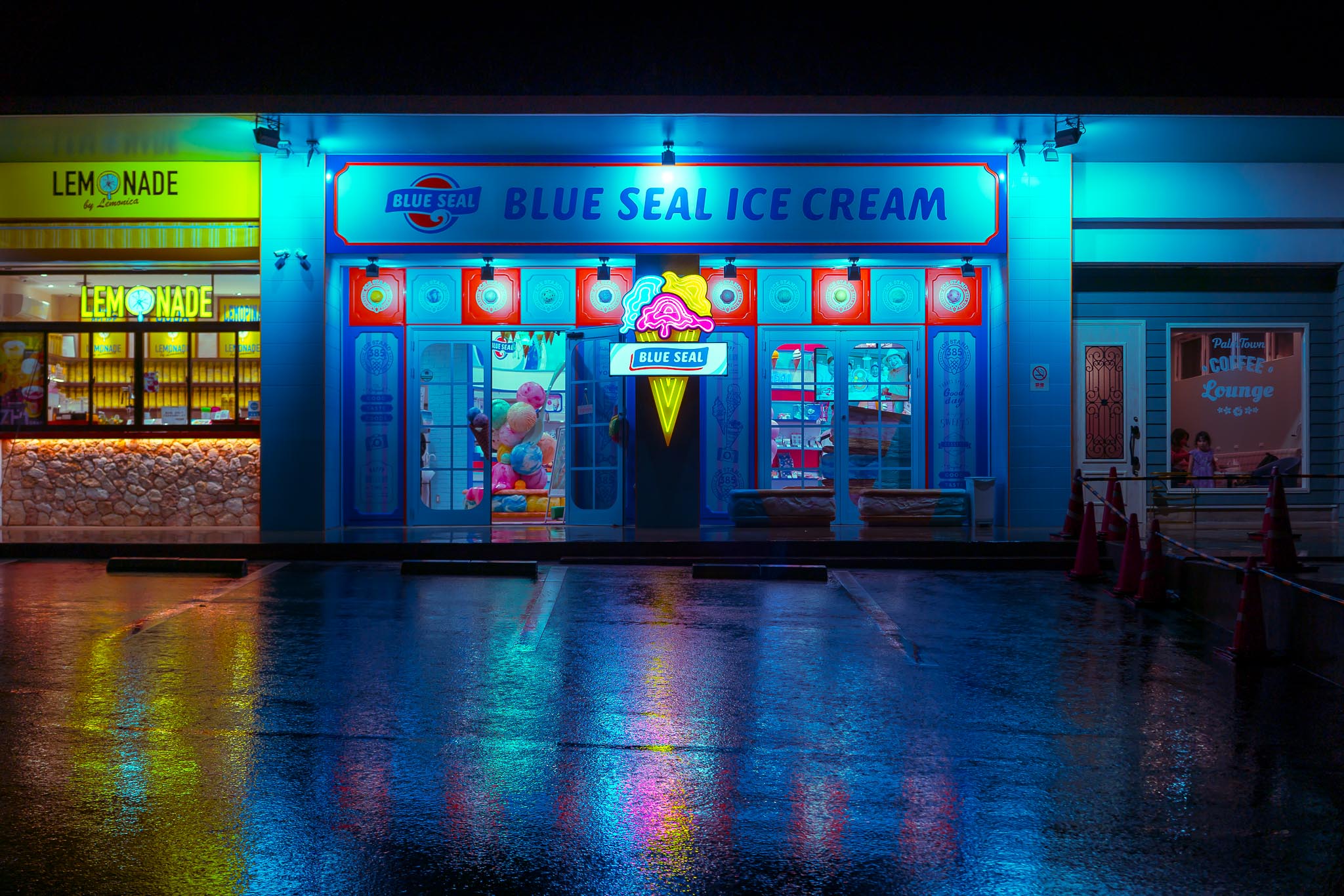
Blue Seal Ice Cream is Okinawa's most visible food institution. It was founded during the American occupation — American-style ice cream production landing on Japanese soil and eventually evolving into something with local flavors alongside the originals. Beniimo, the Okinawan purple sweet potato. Brown sugar from the islands. The American base flavors sitting next to them on the board.
The shops are done in retro diner blue and yellow and white, and on a wet night, the neon sign reflecting off wet asphalt is genuinely beautiful. The light is a specific shade of cyan that doesn't appear often in Tokyo's neon palette — brighter, more primary, American in a way the rest of Japanese commercial signage isn't. I didn't eat any ice cream. I was too busy with the camera, and by the time I thought about it, I'd moved on to the next block.
Naha at Night
The streets around Kokusai-dori and south toward Makishi have the most concentrated nightlife and therefore the most light to work with. The izakayas here feel different from their Tokyo counterparts — more unhurried, some with live sanshin music audible from outside, menus weighted toward rafute, goya champuru, Orion beer rather than the yakitori and Kaku highball of the mainland drinking districts. The clientele is more mixed between locals and visitors in a way that doesn't feel touristy. It just feels like a city going about its evening.
The streets that run perpendicular to the main drag are where the photographs are. Find the places where the street narrows and the light concentrates — an izakaya entrance with lanterns, a covered stall with neon, a wet intersection with two light sources reflecting in different directions. Go when it's raining if you have the option. The rain here is warm enough that it doesn't feel like a hardship the way winter rain in Tokyo does.
What Changes When You Shoot Here
In Tokyo I rely on elevated rail infrastructure more than I usually acknowledge — the tracks and columns create natural frames, the station exits concentrate people and light in predictable ways, and the whole city is organized around rail in a manner that makes it navigable on foot in a particular direction. None of that applies here.
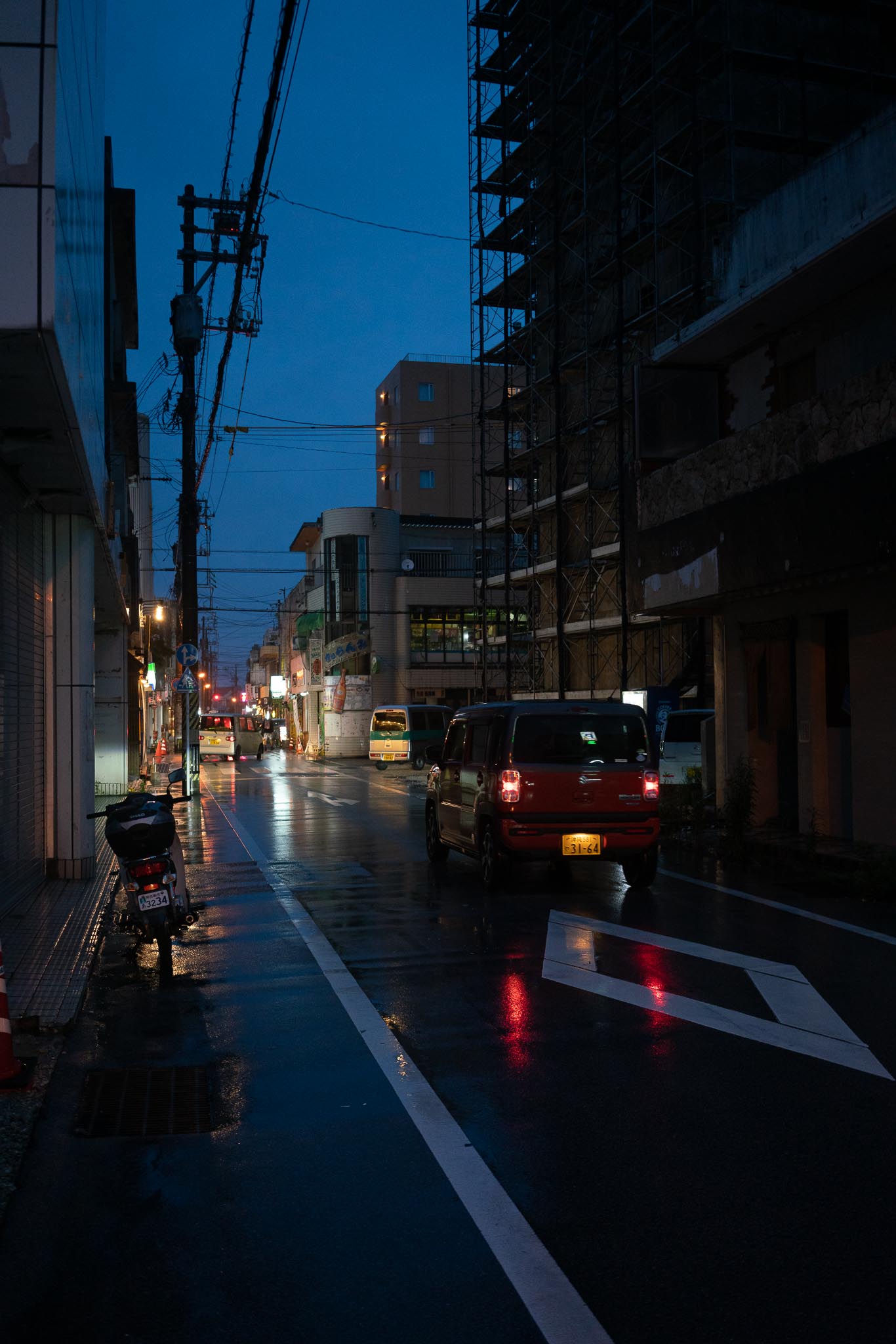
Okinawa requires more wandering and less planning. You cover more ground without being sure what you're looking for, and the photographs come from noticing rather than positioning. The car culture means you're working with vehicles as compositional elements instead of crowds, which changes the energy of the frame entirely. A red kei car pulling away from a blue hour intersection, taillights reflecting in the wet road — that's a different image than anything I could make at a Tokyo crosswalk.
It's worth going specifically to shoot, not just photographing incidentally while doing something else. Okinawa rewards attention. It also rewards going out when it's raining and staying out later than seems sensible. Most of what's interesting is still happening at midnight, and the walk back to wherever you're staying is warm enough to be pleasant.
Shooting Tokyo instead? Let's go out at night.
Book a Night Session in Tokyo →